Hello! This blog is about my daughter Hailey (currently 12 years old) and her experiences living with auditory processing disorder. Auditory Processing Disorder is Hailey's primary issue, however she has also been given the labels Sensory Processing Disorder, Dyslexia, Visual Processing Disorder, Mixed Expressive Receptive Language Disorder and Phonology Disorder at various points in her life.
Showing posts with label classroom learning and accommodations. Show all posts

Tuesday, April 1, 2014

Let Your APD Kid Watch the Movie BEFORE Reading the Book

We had an interesting discussion today on our (Central) Auditory Processing Disorder Support Group about watching movies BEFORE reading the book.

Remember in school how the teachers always made you read the book first and then you got to see the movie; it was the prize after the book was read.  We were told how it was better that we use our own minds to visualize the characters and the scenes before some movie producer does it for us. Being a strong reader, I never questioned this and always did as I was told.  I visualized quite well in my head what I was reading and so didn't feel I needed the movie - it was just a simple pleasure at the end, like dessert after a good meal.

However, our kids with auditory processing disorder aren't usually what one would call a "strong" reader.  They struggle with language processing and often have more difficulty reading and comprehending larger pieces of fiction or non-fiction for that matter.  Their world often relies on visuals and experiences to make meaning.  That is why we give them multi-sensory learning experiences.  That is why we teach math visually.  That is why we incorporate kinesthetics into memorizing facts.

So it only makes sense that watching the movie BEFORE reading the book would aid tremendously in their comprehension and facility in reading the book.

I hadn't really thought enough about this before.  I just noticed anecdotally that my daughter enjoys and comprehends books better that she has previously watched the movie for.  Then when other parents were commenting on the same evidence in their own children, it clicked.

When I was a first grade teacher, I remember learning in my educator prep classes that the thought was children who don't have experiences with the subject matter have more difficulty comprehending the stories.  It has to do with what is called scaffolding and how the brain interprets and retains information. The more experience we have with a topic, the easier it is for our brains to understand and store new information related to that topic.  Think about it - the topics you know well you probably just breeze through learning more about while the ones you are unfamiliar with take a lot longer to read, figure out, and remember in the long run.

So keeping this in mind, we can utilize all we have to help our kids comprehend what they read better.  They can watch the movies.  They can watch documentaries on the topics like Ancient Egypt if that is what they are learning or The Great Depression if that is what the story in the novel is about. They can go to the beach and see tidal pools (if you live nearby) before studying about them in school.  All this multi-sensory exposure helps tremendously!

So to wrap up this rather longish post of me talking about the obvious of using visual and kinesthetic experiences and materials to help our children with auditory processing disorder learn best, I'll just say:

Let them watch the movie BEFORE reading the book!

(And if they are anything like my daughter, they'll watch the movie, watch it again, read the book, and then watch the movie again, and then want to discuss how the book and movie are different.  Along the way, they'll figure out how language and visuals connect, build their reading comprehension skills, understand how interpretation works, how time constraints play into productions, what is considered relevant to the plot and what is not  and therefore can be left out of the movie, etc.  All is good!)


Tuesday, January 28, 2014

Slide Presentation in Common Language on What Auditory Processing Disorder Is (for your friends, family, teachers, etc.)


My dear friend Lynda Waller whom is also co-author of the book Same Journey Different Paths; Stories of Auditory Processing Disorder, created this fantastic slide presentation for auditory processing disorder (also known as central auditory processing disorder).  I hope you find it as beneficial as I do.


Thursday, November 21, 2013

Having APD and Being Overwhelmed By Classes

So I told you all that I would keep you updated on Hailey's progress in taking academic type classes for the first time....

My sweet girl Hailey has auditory processing disorder, is homeschooled, almost 13, and decided to try taking some classes at a local homeschool center.  She signed up for 4 classes that meet one day a week.  At first, she was very excited about "going to school" and she loved seeing her friends and going to class with them and eating lunch together.  However, it didn't take long before the novelty wore off and she was simply overwhelmed.

Her creative writing class ended up being so bad she had to quit.  The teacher did not understand her needs and did a lot of auditory teaching (lecturing) without enough visual support for Hailey. None of the homework assignments were ever written down despite my speaking to the teacher, the principal, and even writing a letter to the principal which was then forwarded on to the other administrative staff.  Futhermore, the teacher started seeing Hailey as a troublemaker because I, her mother, was constantly asking for more than this teacher wanted to give.  The teacher had an attitude around Hailey and never said one nice word to her or about her work ever, nor did she meet any of our requests.  Hailey was in tears just thinking about having to go and so we decided to just quit that class.  

So Hailey continued to take tennis, art, and theater improv.  The theater improv was not ideal, but it was working; this teacher was willing to make accommodations and find ways for Hailey to be successful in the class.  For instance, she was able to recite a smaller memorized poem in class and to do it in sign language as well as speaking - which actually helped Hailey remember it better.

Lunch, which Hailey originally thought was exciting, quickly became "too noisy", "too many kids" and she felt she had to eat "too fast."  Yesterday she actually asked me to stay and eat lunch with her in our car so that she could get away from it all and relax.

The classes are 12 weeks long and we have 2 more to go at this point.  Hailey is really no longer interested in the classes and is simply finishing them up to have completed them.  She has found that it takes so much energy just to be in the classes and try to process everything, that she is not sure it is worth the effort.  She comes home exhausted and needs the whole next day just to unwind.

Unfortunately, she has also stopped putting so much effort into socializing with her friends at class and she just wants to avoid them.  This makes me sad because she really likes these kids, but she is just too exhausted to try anymore.  Yesterday she looked like she was practically cowering away from them as she held her head low and visibly shrunk her body as far away from them as she could; she never acts this way!

Despite it all, she still wants to take community college classes in a few years. She said she just wants to make sure she never has more than one class in a day.

Wednesday, October 30, 2013

Auditory Processing Disorder: The World is Not as Accommodating as We Moms Are

Since Hailey has been taking classes at the homeschool center once a week, I am getting to sit back and just watch her experiences and interactions in ways I haven't before.  I have always been right there beside her, helping her throughout it all.  Now, I see her sit in her class and listen to the teacher (I got to sit in on a class today).  I see her in the hallways.  I see the other children in the classrooms.  I see the other children in the hallways.

I am starting to feel emotions that I haven't felt for a while now.  I am realizing just how much we have organized our family and our homeschooling and even our socializing to accommodate her needs as a person with auditory processing disorder.  We don't even realize we are doing it anymore!  It has become so natural to us.

At "school" (the homeschool center), no one accommodates her needs (not that some of them don't try - they do).  The teacher talks and walks around the room, rambling in long sentences that are circular in theme and connected by only simple threads and tangents as she weaves her web of a story to showcase the point she wants to make.  There is nothing wrong in this way the teacher is talking; in fact it is a very common way people talk when they are just "speaking off the cuff" or rather just talking without a plan of what exactly they are wanting to say and how to get to it.  The other children just listen and seem to follow along to some extent.  Some of the kids jump in with responses to her story or sharing of their own similar experiences.  It is casual and free and a lovely open discussion.  However, for someone with auditory processing disorder, it is too hard to follow. The linearity of the story is lost as moments and details are remembered and added in.  The purpose for listening is lost as it is told at the end rather than the beginning.  The jumping in of others (which brings an interactive component for the other children) just makes it that much more confusing as new stories are presented in the middle of the unfinished original one.  I felt sorry for my sweetheart sitting there lost and bored, I imagined.  The other kids could appreciate the conversational style, but my child with auditory processing disorder found nothing but confusion in it.

In the hallways, the children stand and chat with one another.  Their voices mix and mingle like a choreographed dance of speakers seeming to talk over one another and yet all seem to still be able to follow and understand.  They laugh and smile and seem genuinely happy to be there with one another.  My sweetie with auditory processing disorder stands there lost, with vacant eyes and in silence. Someone will smile at her or touch her shoulder and she will momentarily smile and her eyes will light up, only to hide again in the din of the conversation.  When I ask her about it, she says she likes the kids, but she doesn't understand what they say.

Inside my momma bear wants to barge in to every situation and say "Talk slower.  Talk in phrases. Make sure she understands before you move on.  Don't talk over one another. Use visuals." Yet, I know this is not the right approach.  My sweet girl is almost 13 and she will run into this her entire life!  She has to decide how she wants to handle it, if she wants to handle it.

For classes, of course, we can ask for accommodations that will help her to learn what she wants to learn and do the assignments.  In social exchanges, she will have to speak up and ask others to slow down when she wants or just not understand when she doesn't feel the need to understand but simply to just be there. With her good friends, she does ask them to repeat themselves or speak slower or explain things if she doesn't understand.  In just the group-you-find-yourself-in situations, she says she doesn't really care.

So all this long ramble is to say that I, the mom, am feeling distressed by her situation.  She, the one with auditory processing disorder, is actually handling it all better than me.  She doesn't expect to understand everything and she's okay with that.

Meanwhile, I'm hiring a private sign language tutor to see if this will help her in any way.  She likes the sign language she has taught herself through books and videos, so we're going to try diving more into this as a possible option.  (Update:  I have been reading that "language disorders" (such as Mixed Expressive Receptive Language Disorder which Hailey was diagnosed with at age 6) often cross over into sign language as well as oral language.  Bummer!  We will still pursue the sign language, though, as it might prove helpful all the same.  I'll be sure to let you all know.)

Monday, October 14, 2013

APD Makes Classroom Learning Hard: Having Auditory Processing Disorder and Taking Classes after Homeschooling

As many of you know, Hailey (7th grade) wants to take community college classes as a high-schooler, which is in two years.  So we found a local homeschool center that offers classes to homeschoolers and she signed up for tennis, 3-D art, theater improv, and creative writing.  This way she will have some exposure to taking classes before taking college level classes. (And she really is loving just having the experience of going to school and taking classes and eating lunch with her friends.)

This experience is really showing her and us just how much her auditory processing disorder affects her in a classroom environment.  None of us really could have guessed how difficult some aspects of a classroom learning experience would be.

As Hailey has some great coping skills and really relies a lot on the visual information she is inputting, she is doing very well in the tennis and 3-D art classes.  She says that although she doesn't necessarily understand what the teachers are saying, she can see what they are demonstrating and so knows what to do.  She has always done well at both art and anything physical.

The problems for Hailey are in the creative writing class and the theater improv class.  The areas of difficulty so far are in understanding what is being taught orally, clearly knowing the directions told, and reproducing the spoken or written work under the pressure of time.

The creative writing class is taught by the teacher reading a poem and talking about the use of literary devices such as metaphor, simile, personification, etc.  She tells the students what a quatrain is and reads an example.  So everything is being told to them and at most, they have a sheet in front of them.  The problem is that the sheet is just of the poem being read and so it helps, but it doesn't teach Hailey what a metaphor is for example; she would have to understand what the teacher is saying to get it.  The homework is also told to the students at the end of class.

The theater improv class has the students working in groups and doing improvisational type skits; although not completely improv as they do get to do some planning and preparing before they do their skit.   This is very fun and Hailey is enjoying it, but again she is not processing everything and so tells me that she just lets the others take the lead and she has very few lines.  She says that she can understand the themes and emotions by the body language and so uses that as her guideline as well as in the groups, the other students do make sure she knows what is going on so that she can perform her part.

In creative writing, she has to write in class as well as at home. The writing at home is something she actually looks forward to doing and does well.  She has all the time she needs and she can get help as needed.  In class, she feels pressured to write in the limited time frame given and this worry makes it so that she cannot remember how to spell even simple words and she says she even has trouble just making it look neat on the paper. This was shocking to me as she has good handwriting and has always taken great strides to make her handwriting neat and legible.  She is also a good speller (which is not that common in people with APD it seems) and so I think her and I were both shocked that she would have these problems.

In theater improv class, the teacher has them practice things like accents and tongue twisters and speaking backwards and really fun things like that which makes a lot of sense for a theater class. However, Hailey's APD makes it even more difficult for her to process these and forget having her try to do them; she can say a tongue twister for example if she practices it a lot and even then she has to say it slowly, but on the spot and fast is simply impossible.

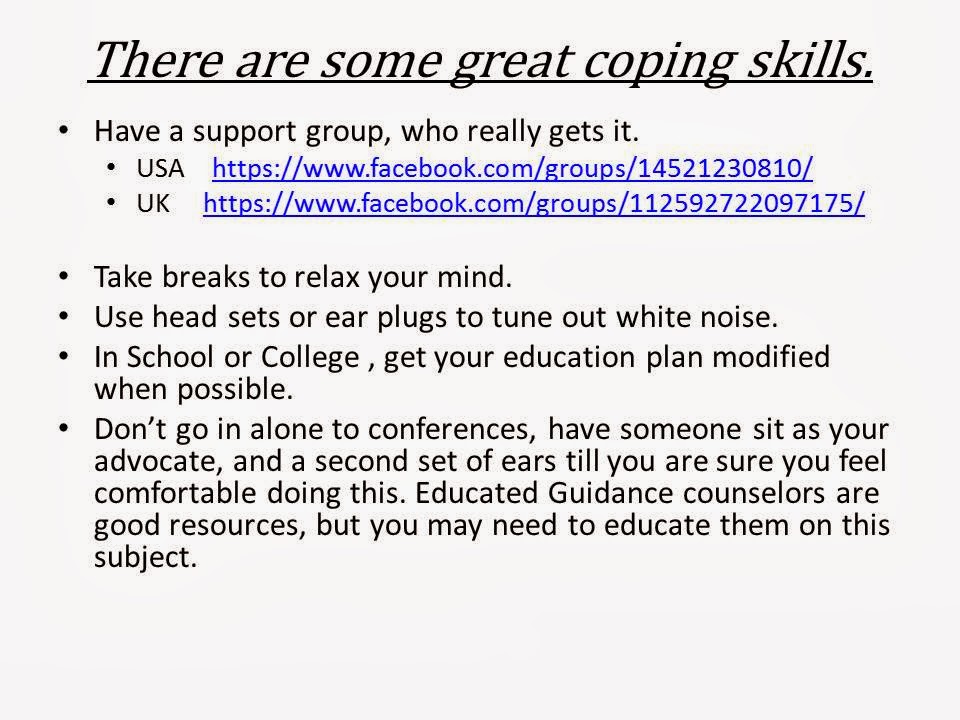
So we are taking advice from all our schooled friends with APD (those on the Facebook APD support groups) and asking for accommodations that may help Hailey in her classes.  My hope is that we can do all the experimenting at these homeschool center classes and then be prepared and ready for community college in a few years.

So far we are going to record the creative writing class so that Hailey can bring it home and we can go over it together.  I can then teach her whatever was taught in class.  She is also going to type her in-class writing and e-mail it to her teacher so that she feels less constrained by time, because typing is faster than handwriting and she doesn't have to worry about making it neat.

In theater improv class, the teacher is now aware of the APD issues and will hopefully make sure Hailey works in a group that helps her be her best as well as she won't keep asking her to do tongue twisters; maybe she can focus on more gestures and body language in acting skills.

I'll certainly keep you all updated on what we discover works and what doesn't.  I do feel very grateful that Hailey has her background of being homeschooled and knowing that she is very smart and capable of learning and accomplishing whatever she wants to do.  I fear that if she hadn't had this successful background to discover herself and feel assured of herself, these experiences of not understanding in class would be too hard on her.

My heart goes out to all the children with APD who go to school everyday to sit in a class where they do not understand what is being taught.  My hope is that more and more teachers are using a multi-sensory approach to teaching and not relying on auditory input only.  Our children with APD are smart and capable and just need to be taught in a way that works for them.