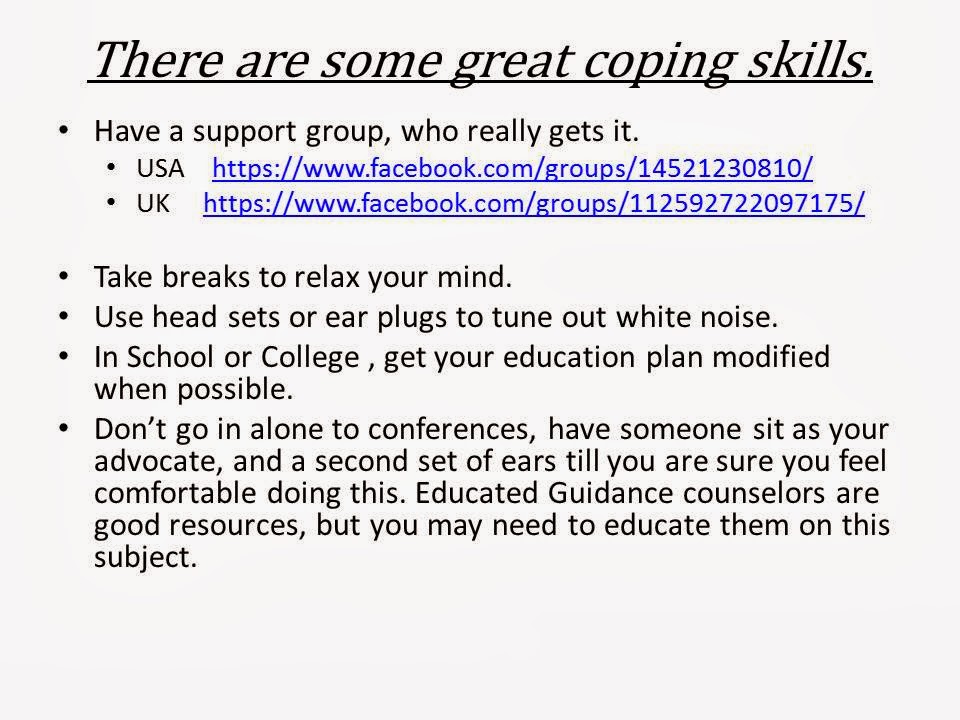
My dear friend Lynda Waller whom is also co-author of the book Same Journey Different Paths; Stories of Auditory Processing Disorder, created this fantastic slide presentation for auditory processing disorder (also known as central auditory processing disorder). I hope you find it as beneficial as I do.
Hello! This blog is about my daughter Hailey (currently 12 years old) and her experiences living with auditory processing disorder. Auditory Processing Disorder is Hailey's primary issue, however she has also been given the labels Sensory Processing Disorder, Dyslexia, Visual Processing Disorder, Mixed Expressive Receptive Language Disorder and Phonology Disorder at various points in her life.
Showing posts with label acceptance and support. Show all posts
Tuesday, January 28, 2014
Saturday, January 4, 2014
Being a Teenager and Socializing with Auditory Processing Disorder - It's Very Difficult!
How is it that I can send my sweet girl of 13 over to a teen night at a friend's house full of happiness and hope and feeling good about herself only to pick her up in tears. This auditory processing disorder keeps making her social life so hard!
She has never handled group socializing very well because she simply cannot keep up with the quick processing needed to talk in a group. She can't "jump in" because she can't even decipher half the time what she is jumping into and by the time she does, the moment has passed and it is too late.
The last time, she came home telling me how a nice boy (the host of the party) told her she could get a drink. She said no thank you and was processing what to say to "keep the conversation going" (we've been working on conversational strategies), but she said he turned and walked away before she could get the words out of her mouth.
Another group problem for her with auditory processing disorder is the sheer noise of too many people talking at once. She says that she cannot even hear her own voice well and doesn't want to shout (shouting to her feels aggressive and she can't stand the sound of it when others do it and so certainly doesn't want to do it herself) but she thinks maybe people don't hear her because when she says hello or tries to speak to someone, she said they often ignore her like she's not even there.
So I keep scouring the internet for advice but always come up empty-handed. Her and I can practice good social skills all we want, but others do not follow the same plan and so it just doesn't work. Teenagers do not socialize according to proper manners or etiquette. Teenagers do not take on the responsibility of making sure everyone is included or wait for someone to process a response - they move on quickly to the next excitement beckoning them. This is normal for teenagerdome - and really most of human interactions in general.
So the teenager that cannot process auditory input or output quickly, who cannot decipher words among a cacophony of talking, and who already feels like all this auditory is difficult and stressful enough already...........well, that teenager has to find an alternative plan. We're working on it!
*** I'm sure Hailey would love to hear how other teenagers with auditory processing disorder (or adults who have lived through it) are coping socially in their lives. So if you have a story to share or some helpful advice or even just the pep talk of "It get's better", please share.
She has never handled group socializing very well because she simply cannot keep up with the quick processing needed to talk in a group. She can't "jump in" because she can't even decipher half the time what she is jumping into and by the time she does, the moment has passed and it is too late.
The last time, she came home telling me how a nice boy (the host of the party) told her she could get a drink. She said no thank you and was processing what to say to "keep the conversation going" (we've been working on conversational strategies), but she said he turned and walked away before she could get the words out of her mouth.
Another group problem for her with auditory processing disorder is the sheer noise of too many people talking at once. She says that she cannot even hear her own voice well and doesn't want to shout (shouting to her feels aggressive and she can't stand the sound of it when others do it and so certainly doesn't want to do it herself) but she thinks maybe people don't hear her because when she says hello or tries to speak to someone, she said they often ignore her like she's not even there.
So I keep scouring the internet for advice but always come up empty-handed. Her and I can practice good social skills all we want, but others do not follow the same plan and so it just doesn't work. Teenagers do not socialize according to proper manners or etiquette. Teenagers do not take on the responsibility of making sure everyone is included or wait for someone to process a response - they move on quickly to the next excitement beckoning them. This is normal for teenagerdome - and really most of human interactions in general.
So the teenager that cannot process auditory input or output quickly, who cannot decipher words among a cacophony of talking, and who already feels like all this auditory is difficult and stressful enough already...........well, that teenager has to find an alternative plan. We're working on it!
![]() |
| click here to see the blog post at adpwarrior17 from which this quote was taken |
*** I'm sure Hailey would love to hear how other teenagers with auditory processing disorder (or adults who have lived through it) are coping socially in their lives. So if you have a story to share or some helpful advice or even just the pep talk of "It get's better", please share.
Wednesday, October 30, 2013
Auditory Processing Disorder: The World is Not as Accommodating as We Moms Are
Since Hailey has been taking classes at the homeschool center once a week, I am getting to sit back and just watch her experiences and interactions in ways I haven't before. I have always been right there beside her, helping her throughout it all. Now, I see her sit in her class and listen to the teacher (I got to sit in on a class today). I see her in the hallways. I see the other children in the classrooms. I see the other children in the hallways.
I am starting to feel emotions that I haven't felt for a while now. I am realizing just how much we have organized our family and our homeschooling and even our socializing to accommodate her needs as a person with auditory processing disorder. We don't even realize we are doing it anymore! It has become so natural to us.
At "school" (the homeschool center), no one accommodates her needs (not that some of them don't try - they do). The teacher talks and walks around the room, rambling in long sentences that are circular in theme and connected by only simple threads and tangents as she weaves her web of a story to showcase the point she wants to make. There is nothing wrong in this way the teacher is talking; in fact it is a very common way people talk when they are just "speaking off the cuff" or rather just talking without a plan of what exactly they are wanting to say and how to get to it. The other children just listen and seem to follow along to some extent. Some of the kids jump in with responses to her story or sharing of their own similar experiences. It is casual and free and a lovely open discussion. However, for someone with auditory processing disorder, it is too hard to follow. The linearity of the story is lost as moments and details are remembered and added in. The purpose for listening is lost as it is told at the end rather than the beginning. The jumping in of others (which brings an interactive component for the other children) just makes it that much more confusing as new stories are presented in the middle of the unfinished original one. I felt sorry for my sweetheart sitting there lost and bored, I imagined. The other kids could appreciate the conversational style, but my child with auditory processing disorder found nothing but confusion in it.
In the hallways, the children stand and chat with one another. Their voices mix and mingle like a choreographed dance of speakers seeming to talk over one another and yet all seem to still be able to follow and understand. They laugh and smile and seem genuinely happy to be there with one another. My sweetie with auditory processing disorder stands there lost, with vacant eyes and in silence. Someone will smile at her or touch her shoulder and she will momentarily smile and her eyes will light up, only to hide again in the din of the conversation. When I ask her about it, she says she likes the kids, but she doesn't understand what they say.
Inside my momma bear wants to barge in to every situation and say "Talk slower. Talk in phrases. Make sure she understands before you move on. Don't talk over one another. Use visuals." Yet, I know this is not the right approach. My sweet girl is almost 13 and she will run into this her entire life! She has to decide how she wants to handle it, if she wants to handle it.
For classes, of course, we can ask for accommodations that will help her to learn what she wants to learn and do the assignments. In social exchanges, she will have to speak up and ask others to slow down when she wants or just not understand when she doesn't feel the need to understand but simply to just be there. With her good friends, she does ask them to repeat themselves or speak slower or explain things if she doesn't understand. In just the group-you-find-yourself-in situations, she says she doesn't really care.
So all this long ramble is to say that I, the mom, am feeling distressed by her situation. She, the one with auditory processing disorder, is actually handling it all better than me. She doesn't expect to understand everything and she's okay with that.
Meanwhile, I'm hiring a private sign language tutor to see if this will help her in any way. She likes the sign language she has taught herself through books and videos, so we're going to try diving more into this as a possible option. (Update: I have been reading that "language disorders" (such as Mixed Expressive Receptive Language Disorder which Hailey was diagnosed with at age 6) often cross over into sign language as well as oral language. Bummer! We will still pursue the sign language, though, as it might prove helpful all the same. I'll be sure to let you all know.)
I am starting to feel emotions that I haven't felt for a while now. I am realizing just how much we have organized our family and our homeschooling and even our socializing to accommodate her needs as a person with auditory processing disorder. We don't even realize we are doing it anymore! It has become so natural to us.
At "school" (the homeschool center), no one accommodates her needs (not that some of them don't try - they do). The teacher talks and walks around the room, rambling in long sentences that are circular in theme and connected by only simple threads and tangents as she weaves her web of a story to showcase the point she wants to make. There is nothing wrong in this way the teacher is talking; in fact it is a very common way people talk when they are just "speaking off the cuff" or rather just talking without a plan of what exactly they are wanting to say and how to get to it. The other children just listen and seem to follow along to some extent. Some of the kids jump in with responses to her story or sharing of their own similar experiences. It is casual and free and a lovely open discussion. However, for someone with auditory processing disorder, it is too hard to follow. The linearity of the story is lost as moments and details are remembered and added in. The purpose for listening is lost as it is told at the end rather than the beginning. The jumping in of others (which brings an interactive component for the other children) just makes it that much more confusing as new stories are presented in the middle of the unfinished original one. I felt sorry for my sweetheart sitting there lost and bored, I imagined. The other kids could appreciate the conversational style, but my child with auditory processing disorder found nothing but confusion in it.
In the hallways, the children stand and chat with one another. Their voices mix and mingle like a choreographed dance of speakers seeming to talk over one another and yet all seem to still be able to follow and understand. They laugh and smile and seem genuinely happy to be there with one another. My sweetie with auditory processing disorder stands there lost, with vacant eyes and in silence. Someone will smile at her or touch her shoulder and she will momentarily smile and her eyes will light up, only to hide again in the din of the conversation. When I ask her about it, she says she likes the kids, but she doesn't understand what they say.
Inside my momma bear wants to barge in to every situation and say "Talk slower. Talk in phrases. Make sure she understands before you move on. Don't talk over one another. Use visuals." Yet, I know this is not the right approach. My sweet girl is almost 13 and she will run into this her entire life! She has to decide how she wants to handle it, if she wants to handle it.
For classes, of course, we can ask for accommodations that will help her to learn what she wants to learn and do the assignments. In social exchanges, she will have to speak up and ask others to slow down when she wants or just not understand when she doesn't feel the need to understand but simply to just be there. With her good friends, she does ask them to repeat themselves or speak slower or explain things if she doesn't understand. In just the group-you-find-yourself-in situations, she says she doesn't really care.
So all this long ramble is to say that I, the mom, am feeling distressed by her situation. She, the one with auditory processing disorder, is actually handling it all better than me. She doesn't expect to understand everything and she's okay with that.
Meanwhile, I'm hiring a private sign language tutor to see if this will help her in any way. She likes the sign language she has taught herself through books and videos, so we're going to try diving more into this as a possible option. (Update: I have been reading that "language disorders" (such as Mixed Expressive Receptive Language Disorder which Hailey was diagnosed with at age 6) often cross over into sign language as well as oral language. Bummer! We will still pursue the sign language, though, as it might prove helpful all the same. I'll be sure to let you all know.)
Saturday, July 20, 2013
Perseverance, My Daughter with APD, and Her Latest Goal
"Perseverance: steady persistance in a course of action, a purpose, a state, etc., especially in spite of difficulties, obstacles, or discouragement." http://dictionary.reference.com/browse/perseverance
I love this definition of perseverance from FreeDictionary.com and it totally describes the go-getter, never-let-anything-get-in-the-way nature of my sweet Hailey. I don't know if it is her auditory processing disorder which has made life so much more difficult for her or just her nature as she is, but Hailey has always persevered.
Recently Hailey (who is 12 1/2 years old at the moment) has decided that rather than being an artist for a living or opening a bakery or any of the other thoughts she has had about a future career, she will be an occupational therapist. She wants to help children who have disabilities or special needs and she is particularly interested in working with sensory processing disorder.
If you knew Hailey, you would know that she doesn't just decide something, but she makes a commitment to her decisions! She insisted that we immediately find out all we could about occupational therapists and exactly what she has to do to become one. So we found out that one of our local community colleges has an associates program in occupational therapy and the college accepts students as young as 14 years old (although perhaps not in the associates program per se). Yup! You guessed it; Hailey wants to go when she is 14.
So she made the decision, found out the path is to go to the community college (and later to a university for her masters degree), and has decided her current plan of action. She wants to take a few classes at a local homeschool co-op in order to get comfortable being in a class; put a large emphasis on improving her writing skills; learn higher level math (we're going to try pre-algebra); and learn sign language. These are all her goals that she came up with! She told me that she wants to be sure the community college will accept her at age 14 as someone capable of taking their classes.
She really does put a lot of pressure on herself and so I try to be supportive and yet help her to realize that she doesn't have to accomplish everything right away and she doesn't have to go to college at 14 years old. (My plan is for one class at a time at the community college, but she insists she will handle two at a time.) Yes, she is determined! As she put it to me, "I want to DO something with my life and I'm tired of waiting!" (Hmm.... this makes me wonder about our society's lack of opportunities for teens to do more.)
Anyway, I have no idea if she will go to the community college at 14; we'll have to wait and see. What I do know is that she has perseverance and she will accomplish all she sets out to accomplish in life, or change her mind along the way and set her sights on new goals as she sees fit and then accomplish those.
So what do you think? Has APD made you or your child more perseverant?
I love this definition of perseverance from FreeDictionary.com and it totally describes the go-getter, never-let-anything-get-in-the-way nature of my sweet Hailey. I don't know if it is her auditory processing disorder which has made life so much more difficult for her or just her nature as she is, but Hailey has always persevered.
Recently Hailey (who is 12 1/2 years old at the moment) has decided that rather than being an artist for a living or opening a bakery or any of the other thoughts she has had about a future career, she will be an occupational therapist. She wants to help children who have disabilities or special needs and she is particularly interested in working with sensory processing disorder.
If you knew Hailey, you would know that she doesn't just decide something, but she makes a commitment to her decisions! She insisted that we immediately find out all we could about occupational therapists and exactly what she has to do to become one. So we found out that one of our local community colleges has an associates program in occupational therapy and the college accepts students as young as 14 years old (although perhaps not in the associates program per se). Yup! You guessed it; Hailey wants to go when she is 14.
So she made the decision, found out the path is to go to the community college (and later to a university for her masters degree), and has decided her current plan of action. She wants to take a few classes at a local homeschool co-op in order to get comfortable being in a class; put a large emphasis on improving her writing skills; learn higher level math (we're going to try pre-algebra); and learn sign language. These are all her goals that she came up with! She told me that she wants to be sure the community college will accept her at age 14 as someone capable of taking their classes.
She really does put a lot of pressure on herself and so I try to be supportive and yet help her to realize that she doesn't have to accomplish everything right away and she doesn't have to go to college at 14 years old. (My plan is for one class at a time at the community college, but she insists she will handle two at a time.) Yes, she is determined! As she put it to me, "I want to DO something with my life and I'm tired of waiting!" (Hmm.... this makes me wonder about our society's lack of opportunities for teens to do more.)
Anyway, I have no idea if she will go to the community college at 14; we'll have to wait and see. What I do know is that she has perseverance and she will accomplish all she sets out to accomplish in life, or change her mind along the way and set her sights on new goals as she sees fit and then accomplish those.
So what do you think? Has APD made you or your child more perseverant?
Labels:
acceptance and support,
mathematics,
reading,
self-esteem
Wednesday, June 26, 2013
Going to a Concert with APD: Don't Forget the Earplugs!
"My ears felt like they were going numb because of how loud the noise was. Did you feel that too?" Hailey had been bent over, squeezing her eyes tight and holding her ears with her hands. She looked like someone in pain and I knew I needed to get her out of there quickly.
For weeks Hailey had looked forward to going to a concert with her two closest and dearest friends. As we were going to see the Go-Gos and the B-52s, the girls all bought 1980s prom style clothes and fixed their hair up with 1980s styles (Hailey had a side pony tail.) Us moms sat behind them in seats close to the stage, so we could all see very well. However, the NOISE was incredibly loud!
Hailey desperately wanted to be with her friends and enjoy the show together, but she just couldn't handle the noise and mommy over here neglected to bring any earplugs. So I escorted her from our close-to-the-stage seats to the farthest corner of the lawn, away from the noise as we could get and still be in the amphitheater. This made the noise at a tolerable level and she felt immediately much better. However, even there after a time she got to her threshold of bearability and started to melt; tears welled up in her eyes and she needed hugged and cold water and to leave the amphitheater. She missed being with her friends, but just couldn't handle the noise.
Hailey's thoughts:
"I couldn't understand the words. All I heard was blah, blah, blah."
"I liked eating a turkey leg". (They had them there to purchase.)
"Even though I couldn't hear the words, I could still tell the difference between the Go-Gos and the B-52s by the way the beat sounded. I liked the beat and the sound of the B-52s better."
"My friends didn't think it was too loud."
"If I ever go to a concert again, I will bring very good ear plugs or something even better than earplugs because even blocking my ears, it was too loud."
For weeks Hailey had looked forward to going to a concert with her two closest and dearest friends. As we were going to see the Go-Gos and the B-52s, the girls all bought 1980s prom style clothes and fixed their hair up with 1980s styles (Hailey had a side pony tail.) Us moms sat behind them in seats close to the stage, so we could all see very well. However, the NOISE was incredibly loud!
Hailey desperately wanted to be with her friends and enjoy the show together, but she just couldn't handle the noise and mommy over here neglected to bring any earplugs. So I escorted her from our close-to-the-stage seats to the farthest corner of the lawn, away from the noise as we could get and still be in the amphitheater. This made the noise at a tolerable level and she felt immediately much better. However, even there after a time she got to her threshold of bearability and started to melt; tears welled up in her eyes and she needed hugged and cold water and to leave the amphitheater. She missed being with her friends, but just couldn't handle the noise.
Hailey's thoughts:
"I couldn't understand the words. All I heard was blah, blah, blah."
"I liked eating a turkey leg". (They had them there to purchase.)
"Even though I couldn't hear the words, I could still tell the difference between the Go-Gos and the B-52s by the way the beat sounded. I liked the beat and the sound of the B-52s better."
"My friends didn't think it was too loud."
"If I ever go to a concert again, I will bring very good ear plugs or something even better than earplugs because even blocking my ears, it was too loud."
Tuesday, June 18, 2013
How I Freed Myself from Perfectionism (This is my philosophy with my own children - to be freely themselves without comparison.)
"I let go of perfectionism in college and it was the best thing I ever did for myself."
I wrote the above sentence today in response to an article I read, and I realized just how powerful this statement is. You see, I grew up being a straight A, top of the class, "gifted" student who was expected to always be the best, do the best, etc. When the other kids were learning math in class, the teacher would give me a math textbook and say "Go to town and do whatever you want." So, I would teach myself math for as long as I wanted and then when I was bored of that, she'd hand me a stack of my peers' work to grade. When the other kids were reading one novel, I was often given another chosen by her (never chosen by me) to read on my own in order to keep me busy. I didn't even have my after school time to myself as my father felt sports was an important aspect of every person and so I had to do gymnastics four times a week for four plus hours each day. Not only that, but when I got to high school, I had to do volunteer work and I had to join clubs like the National Honors Society and French Club, because that was expected of "the brightest of the bright".
And so this went on until I went away to college and I didn't even questions where I would go; why I would go to what was considered the most elite, most difficult to get into, where the "brightest of the bright" in my state go to. I applied early, got into early admissions, signed up for the classes that went along with the plan I had been going on established by someone else: each year take another English class, another math class, another history class, another science class, another foreign language class, and one elective. I NEVER EVEN QUESTIONED WHAT I WANTED TO DO!
My first year of college, I was blessed in many ways. I took a math class that was a weed-out course for the engineering program. For this reason, it was intended to be very difficult so that only the most talented in math would continue on to the engineering program. I was getting about a C average and that was something I had never done before. I went to my professor's office to speak to him about it, and he told me not to worry, that I was doing extremely well for that course and that if I was getting a C then I would probably end up getting a B by the end, which was better than the majority of the students. Hmmm.... this made no sense to me; why would it be done this way?
So I continued on for a few weeks more in this math class when I started speaking to my college peers and realized that not everyone was even taking a math class. I realized that in college, people have a lot more flexibility to take classes that interest them and I was asked what I was interested in. Seriously, nobody had ever asked that before of me! I was always expected to take the hardest classes in every subject and to get straight As; what was this what I am interested in thing? I had no idea that was the purpose of education. Who forgot to tell me that!
So I dropped the math class and the next semester I took an introduction to poetry writing class. My instructor was a generous left-over beatnik from days gone by and he encouraged me to write from my heart and from my passion. He told me some of the best kept secrets I needed to hear: if you want to do something great, you have to allow yourself to make mistakes; if you want to learn something new, you have to allow yourself to be a beginner; life is meant to be lived with passion and happiness - do what you want and don't worry about where you compare to others, because it is YOUR LIFE.
So I continued to take poetry writing classes with this wonderful old beatnik and I learned about myself. I learned what I liked, what I didn't like, who I wanted to be, to try new things if they interested me without care of whether or not I would be "the best". Yes, my parents wondered what the heck I would ever do with all these poetry classes and wondered why I wasn't pursuing something that would "meet my potential" such as being a lawyer or doctor or corporate executive. I just learned to smile and say it was my life and I would do what spoke to my heart and my soul.
So that is how I learned to let go of the very limiting world of perfectionism. I learned to be happy just to be happy, not related to being "the best" at anything. I learned to be myself. And one of the most fantastic after effects is that I can not only be happy being me, but I can also be happy for others being them. I don't need to be "the best" which meant comparing myself to others or comparing myself to some standard set by someone else. It truly is a wonderful world when you are free to be yourself.
And that is why I encourage my children to be themselves; to not compare themselves to others because we are all wonderfully our own unique selves with our own passions, interests, talents, and areas that we just don't seem to be very good at; and to honor everyone else for being themselves without jealousy or the need to compete. Life is not a competition to excel at; Life is YOUR LIFE. Find what brings you enjoyment and be yourself for all that you wonderfully are.
Thank you for letting me ramble here with a little about myself in order to showcase a belief I have in raising my children. I hope it brings some comfort and hope to others.
I wrote the above sentence today in response to an article I read, and I realized just how powerful this statement is. You see, I grew up being a straight A, top of the class, "gifted" student who was expected to always be the best, do the best, etc. When the other kids were learning math in class, the teacher would give me a math textbook and say "Go to town and do whatever you want." So, I would teach myself math for as long as I wanted and then when I was bored of that, she'd hand me a stack of my peers' work to grade. When the other kids were reading one novel, I was often given another chosen by her (never chosen by me) to read on my own in order to keep me busy. I didn't even have my after school time to myself as my father felt sports was an important aspect of every person and so I had to do gymnastics four times a week for four plus hours each day. Not only that, but when I got to high school, I had to do volunteer work and I had to join clubs like the National Honors Society and French Club, because that was expected of "the brightest of the bright".
And so this went on until I went away to college and I didn't even questions where I would go; why I would go to what was considered the most elite, most difficult to get into, where the "brightest of the bright" in my state go to. I applied early, got into early admissions, signed up for the classes that went along with the plan I had been going on established by someone else: each year take another English class, another math class, another history class, another science class, another foreign language class, and one elective. I NEVER EVEN QUESTIONED WHAT I WANTED TO DO!
My first year of college, I was blessed in many ways. I took a math class that was a weed-out course for the engineering program. For this reason, it was intended to be very difficult so that only the most talented in math would continue on to the engineering program. I was getting about a C average and that was something I had never done before. I went to my professor's office to speak to him about it, and he told me not to worry, that I was doing extremely well for that course and that if I was getting a C then I would probably end up getting a B by the end, which was better than the majority of the students. Hmmm.... this made no sense to me; why would it be done this way?
So I continued on for a few weeks more in this math class when I started speaking to my college peers and realized that not everyone was even taking a math class. I realized that in college, people have a lot more flexibility to take classes that interest them and I was asked what I was interested in. Seriously, nobody had ever asked that before of me! I was always expected to take the hardest classes in every subject and to get straight As; what was this what I am interested in thing? I had no idea that was the purpose of education. Who forgot to tell me that!
So I dropped the math class and the next semester I took an introduction to poetry writing class. My instructor was a generous left-over beatnik from days gone by and he encouraged me to write from my heart and from my passion. He told me some of the best kept secrets I needed to hear: if you want to do something great, you have to allow yourself to make mistakes; if you want to learn something new, you have to allow yourself to be a beginner; life is meant to be lived with passion and happiness - do what you want and don't worry about where you compare to others, because it is YOUR LIFE.
So I continued to take poetry writing classes with this wonderful old beatnik and I learned about myself. I learned what I liked, what I didn't like, who I wanted to be, to try new things if they interested me without care of whether or not I would be "the best". Yes, my parents wondered what the heck I would ever do with all these poetry classes and wondered why I wasn't pursuing something that would "meet my potential" such as being a lawyer or doctor or corporate executive. I just learned to smile and say it was my life and I would do what spoke to my heart and my soul.
So that is how I learned to let go of the very limiting world of perfectionism. I learned to be happy just to be happy, not related to being "the best" at anything. I learned to be myself. And one of the most fantastic after effects is that I can not only be happy being me, but I can also be happy for others being them. I don't need to be "the best" which meant comparing myself to others or comparing myself to some standard set by someone else. It truly is a wonderful world when you are free to be yourself.
And that is why I encourage my children to be themselves; to not compare themselves to others because we are all wonderfully our own unique selves with our own passions, interests, talents, and areas that we just don't seem to be very good at; and to honor everyone else for being themselves without jealousy or the need to compete. Life is not a competition to excel at; Life is YOUR LIFE. Find what brings you enjoyment and be yourself for all that you wonderfully are.
Thank you for letting me ramble here with a little about myself in order to showcase a belief I have in raising my children. I hope it brings some comfort and hope to others.
Sunday, May 26, 2013
Do Children with APD Have More Fears than Their Peers?
My spouse and I were talking the other day about how our sweet girl with auditory processing disorder has always needed more reassurance than our two non-APD boys. She asks five, six, seven times every night if we've locked all the doors. She tells us all to have safe dreams before sleeping and insists we tell her the same thing and it can't be "good dreams", it has to be "SAFE dreams".
It's not just the night time sleeping that brings concerns for her. Whenever I (being mom) leave the house without her, she looks at me deeply in the eyes and tells me to drive very, very safely and be very, very careful to not get hurt and come home to her safely. Then she gives me at least three hugs and longingly waves me off. She is worried that something will happen to me and she will never see me again. I think this is because she still relies very much on me for support; I'm the one person in her world that truly understands her.
My spouse gets concerned that maybe this is not the APD, but I really feel that it is. I imagine that if I lived in a world where I understood sometimes as little as half of what I heard each day, I'd feel pretty lost and confused and scared. I would rely that much more on those I trust would support me and care for me and always be on my side. It just makes sense to me.
As our sweet girl gets older, she does make strides in her comfort level with living in this world. She used to never be able to be away from me at all without acting fearful; now she does let me leave for several hours away without her and she functions just fine, enjoying her life. She used to need constant sensory support such as something to chew on and her little blanket "Nonny" to hold for support, but she stopped carrying Nonny and she stopped needing to have something in her mouth. She used to need me to do things like go into the locker room with her at ice skating and now she asks me to stay out so she can be on her own like her peers. When she was little, she did sleep in our room with us until she was seven years old; we let her decide when she wanted to sleep in her own room. (We did the same for our boys of course.) Now she always sleeps in her own room and even feels comfortable staying the night at her friends' homes. So as time goes on and she gets older, she does feel more "safe" and doesn't need as much support as she once did. Maybe she hasn't been on the same path as her peers and maybe her time frame has been different, but it is her path, and in her time, and therefore it is what works best for her.
I am a firm believer that children grow in the times and ways that work best for them and if she has more fears, then I will help her through them by providing the support she needs now, showing her how to support herself but not taking that support away from her until she has asked for me to do so; she knows herself even better than I know her and I respect that. I want her to know without a doubt that I am there for her whenever she needs me, without judgement and without fear that I will suddenly just stop when she isn't ready for me to do so.
It's not just the night time sleeping that brings concerns for her. Whenever I (being mom) leave the house without her, she looks at me deeply in the eyes and tells me to drive very, very safely and be very, very careful to not get hurt and come home to her safely. Then she gives me at least three hugs and longingly waves me off. She is worried that something will happen to me and she will never see me again. I think this is because she still relies very much on me for support; I'm the one person in her world that truly understands her.
My spouse gets concerned that maybe this is not the APD, but I really feel that it is. I imagine that if I lived in a world where I understood sometimes as little as half of what I heard each day, I'd feel pretty lost and confused and scared. I would rely that much more on those I trust would support me and care for me and always be on my side. It just makes sense to me.
As our sweet girl gets older, she does make strides in her comfort level with living in this world. She used to never be able to be away from me at all without acting fearful; now she does let me leave for several hours away without her and she functions just fine, enjoying her life. She used to need constant sensory support such as something to chew on and her little blanket "Nonny" to hold for support, but she stopped carrying Nonny and she stopped needing to have something in her mouth. She used to need me to do things like go into the locker room with her at ice skating and now she asks me to stay out so she can be on her own like her peers. When she was little, she did sleep in our room with us until she was seven years old; we let her decide when she wanted to sleep in her own room. (We did the same for our boys of course.) Now she always sleeps in her own room and even feels comfortable staying the night at her friends' homes. So as time goes on and she gets older, she does feel more "safe" and doesn't need as much support as she once did. Maybe she hasn't been on the same path as her peers and maybe her time frame has been different, but it is her path, and in her time, and therefore it is what works best for her.
I am a firm believer that children grow in the times and ways that work best for them and if she has more fears, then I will help her through them by providing the support she needs now, showing her how to support herself but not taking that support away from her until she has asked for me to do so; she knows herself even better than I know her and I respect that. I want her to know without a doubt that I am there for her whenever she needs me, without judgement and without fear that I will suddenly just stop when she isn't ready for me to do so.
Tuesday, May 14, 2013
Homeschooling a Child with Special Needs/Learning Disabilities Avoids A Lot of the Anxiety
I want to start by saying that I know many people cannot homeschool for various reasons (in some countries it is actually illegal) and others choose not to homeschool because they feel that school is best for their child. I feel very fortunate that homeschooling was an option for us.
Here are some of the benefits of homeschooling my child with auditory processing disorder:
- She is not forced to sit for 7+ hours each day at school trying to process auditory input.
- She is not feeling judged or compared constantly by teachers giving grades or her peers making comments.
- She is not having to try to socialize with groups of her peers who do not understand her. (Yes she does run into social problems because of her APD, but it is not on a daily basis.)
- She has time to pursue her interests like art and baking or even watch a movie 3 times or more until she finally feels she has processed all of it and gained any wisdom from it she could.
- She learns at her own pace and her own style. (She is visual and auditory input must be kept limited.)
- She reads what interests her and takes as much time as she needs to read it. (Just the other day, she read some poems by Langston Hughes and wrote a poem as a response to her readings, all of her own choosing.)
- She writes because she enjoys it and takes as much time as she needs to write.
- She does math problems because she actually likes solving them. Yes, she likes math because she takes her time and does what interests her at that moment. (She is currently above "grade level" in math.)
- She has me, her mom, available to her for help and guidance and support as needed.
- We can hand-pick friendships to pursue that are more conducive to success as well as I can be here to help her process what is happening as I too know her friends as well as their parents. (Hopefully these skills will transfer to her abilities to stop and question her reactions, to give people the benefit of the doubt, and to stand up for herself when it is needed.)
- She can take breaks and just relax, be alone, go jump on the trampoline, eat something, etc. as she feels the need for them. (This I believe helps her learn to be aware of herself and her needs and how to deal with them.)
- She can start taking community college courses at 15 years old (which she wants to do) and take them one at a time to start, then build from there. Colleges seem to be more accommodating to special needs and learning disabilities than the public school system, so that is a big plus.
So I imagine this list can go on and on, but the real point is that she does not suffer from a lot of the anxiety and depression that I see so many others on our Facebook support groups going through. Sure, she does have anxiety from time to time, but it isn't a constant. She also went through a period of depression when she was bullied by some homeschoolers at a co-op we belonged to and promptly quit. It took us a few years to rebuild her self-esteem after that bullying episode, but now she is happy with herself again and I believe/hope she is now stronger and more able to fend off any such attacks in the future should they occur.
So although homeschooling isn't an option for everyone, it is certainly worth considering if you have a child with special needs/learning disabilities.
Sunday, May 12, 2013
"Same Journey Different Paths" --- I Co-Wrote a Book about Auditory Processing Disorder
So I suppose it is about time to mention on my blog, and not just the blog's Facebook page, that a book I wrote with 14 other authors about auditory processing disorder is about to be published:
Authors from around the world have come together to share their lives or that of their children living with Auditory Processing Disorder.
Description
"Once we were all mothers and children from around the world dealing with auditory processing disorder on our own; we felt all alone on our journeys, not knowing anyone else with this disability. There wasn’t a lot of information available to us about how to deal with this disorder and we were looking for advice, help, and just someone who understood what we were going through.
Then one day, in our own times and ways, we found each other via the internet and more specifically Facebook. We used this well-known social networking site to establish and/or join support groups for people with auditory processing disorder. Through these groups, we started talking to one another, sharing advice, telling our stories, and developing a relationship with each other. These support groups became our lifeline where we knew we could turn to others who would be there for us.
Through the internet, we who live far away from one another and have never even met each other in person as of the printing of this book, have grown to care for one another and each of our families. We laugh, we cry, we share our successes and help find answers to help each other. We came together to write this book in the hope it will help others and no one will have to feel alone again on this journey."
Then one day, in our own times and ways, we found each other via the internet and more specifically Facebook. We used this well-known social networking site to establish and/or join support groups for people with auditory processing disorder. Through these groups, we started talking to one another, sharing advice, telling our stories, and developing a relationship with each other. These support groups became our lifeline where we knew we could turn to others who would be there for us.
Through the internet, we who live far away from one another and have never even met each other in person as of the printing of this book, have grown to care for one another and each of our families. We laugh, we cry, we share our successes and help find answers to help each other. We came together to write this book in the hope it will help others and no one will have to feel alone again on this journey."
Same Journey Different Paths official website: www.apdbook.com
Facebook Page: https://www.facebook.com/SameJourneyDifferentPaths
I have loved the entire process of working on this book from writing it and editing it to managing the process with my co-managers Nancy Pittman Outten and Bonnie Landau Weed.
It will be available for purchase in June from Stoelting Company (I'll post a link to them as soon as it is available) as well as on Amazon, and will be available both in paperback and as an e-book.
PS: As a bonus, one of Hailey's drawings will be in the book! It's just a sketch she did, but it is so wonderfully full of emotion.
Wednesday, May 1, 2013
Super Ears - When Your Child with APD Can Hear Whispers From Across the Room
When she was just a little toddler, I remember having her sitting in the grocery cart in front of me while I strolled down the aisles. Suddenly she would start nervously repeating "Baby! Baby! Baby!" and sucking her fingers and rubbing her "nonny" (her little blanket she carried around for comfort). This was my sign that she was in distress and she was telling me why: some baby somewhere was crying. So I would stop and listen and sure enough, somewhere in the distance, across the store, there was just the faintest sound of some infant crying. It was uncanny how she could do this over and over again.
Now that our sweet Hailey is 12 years old, we forget sometimes that she can do this amazing hearing thing and we'll whisper something in an adjoining room to where she is. Of course, like most parents, we think we are speaking "privately" by doing this, but sure enough when we walk in the room with our girl, she asks a question or makes a comment that reminds us that she hears us, even when we think she does not.
Of course, with Hailey's auditory processing disorder, she hasn't always processed what she heard us whisper correctly and then we are left with either having to explain everything or say, "Sweetie, we didn't mean for you to hear that and we'd rather not talk about it with you." To which comment she sighs, understanding and yet feeling left out. (Then I worry that I need to talk to her because I have no idea what she thinks she heard.)
Does APD affect you or your child in this way? Do you or he/she have super ears?
![]() |
| Lindsey Wagner from the 1970's television show "The Bionic Woman" (in the show her character had a bionic ear and could hear sounds from extremely far away). |
Sunday, April 14, 2013
Processing Conversations with Auditory Processing Disorder: You Don't Always Understand
A few days ago I posted on Facebook a quote from a young woman* with auditory processing disorder. She described how she understands maybe only a few words in a conversation and uses body language and context to try to figure out what the other person is saying. Well, I knew my daughter did this to some extent, but I hadn't really been paying as close attention to this in a long time.
At home, in an ideal environment with people she is very familiar with, my Hailey actually does very well at understanding most things; her only real difficulties at home seem to be in watching television as she often misses the conversations there. That really isn't a problem though as we just pause the tv (we use a dvr and it is wonderful for this reason) and help her understand if she wants the help. Of course most of the time she is content to just half-understand the words spoken, because let's face it, television is not usually very complex and is highly visual.
So we were going along in our nice little world of home without thinking too much of the real difficulties Hailey has with understanding what people say. Socially, she has friends and the group aspect of conversations still make it too difficult to follow a conversation, so she just follows along at the edges of the group. With her close friends, she has one-on-one conversations and that works well. We knew this and felt okay with it all. However, with the information from the young woman that I posted on my Facebook page, I started paying more attention to where maybe her lack of understanding is causing her real problems.
As many of you know, Hailey ice skates. She is also in a theater on ice class, which she really enjoys. Mostly, she just has to follow along with what the others are doing and takes in her input visually. Yes, she has to follow the music to stay on beat, but luckily she does not have the prosodic form of APD and so can hear the beat of the music well enough. Well, her troupe is starting to learn a new program and her coach has decided to allow each skater some more individual input. With this is mind, her coach took her aside to talk to her about what character she would like to be in the upcoming program; her coach has become aware that Hailey does not comprehend well in the group setting and so kindly spoke to her privately, making eye contact.
Hailey didn't want to make eye contact, kept shrugging her shoulders, and desperately wanted me to speak for her. I tried to help without interfering and tried to encourage her to speak for herself; she is 12 years old and can handle these things. She did okay, but it was clear that she doesn't understand as much as I would have thought. Later in the car, alone with me, she said some things to me about the conversation she had with her coach and she got quite a few things very wrong; she thought she heard things that were never said.
So even though her coach spoke to her one-on-one and she had me there to help, Hailey still didn't process it all. The surrounding factors, I believe, were:
All of this just helps me to realize that my sweet Hailey works really hard to make sense of what she does hear and unfortunately, she still misunderstands quite a bit if not in an ideal situation with a familiar context. Being homeschoolers, I forget how much this is a problem because she is in an ideal environment most of the time and she is very familiar with our speaking styles and not at all intimidated by us.
*Kendra Ross: "I have been called a liar by teachers, students.... I understand that APD is so hard to deal with and not understanding what someone is saying to you; the best thing I do that helps me when someone is talking to me and I have no idea what they are saying is reading their body language. If that doesn't work even if I don't understand what someone is saying, I use whatever words I do hear, and replay that back to them. Like today this one girl in my class was telling me about what she is going to do for her video, and it was a long hallway, she slurred. I had no clue what she was talking about until i got these words "needed.........talk.......teacher". Even though it was just 3 words, I got that she needed to talk to our video teacher about what she is going to do for her final. Then I wished her good luck. Now if I'm having a bad day, then I will just nod at the appropriate times until the conversation is over. Which happens, but it's best to try and understand the situation, even if it only 1 piece of info. It is key to have your [children] develop the skill of understanding a situation even just on body language. And the most important skill is understanding the situation and filling in the blanks. Hope this helps."
At home, in an ideal environment with people she is very familiar with, my Hailey actually does very well at understanding most things; her only real difficulties at home seem to be in watching television as she often misses the conversations there. That really isn't a problem though as we just pause the tv (we use a dvr and it is wonderful for this reason) and help her understand if she wants the help. Of course most of the time she is content to just half-understand the words spoken, because let's face it, television is not usually very complex and is highly visual.
So we were going along in our nice little world of home without thinking too much of the real difficulties Hailey has with understanding what people say. Socially, she has friends and the group aspect of conversations still make it too difficult to follow a conversation, so she just follows along at the edges of the group. With her close friends, she has one-on-one conversations and that works well. We knew this and felt okay with it all. However, with the information from the young woman that I posted on my Facebook page, I started paying more attention to where maybe her lack of understanding is causing her real problems.
As many of you know, Hailey ice skates. She is also in a theater on ice class, which she really enjoys. Mostly, she just has to follow along with what the others are doing and takes in her input visually. Yes, she has to follow the music to stay on beat, but luckily she does not have the prosodic form of APD and so can hear the beat of the music well enough. Well, her troupe is starting to learn a new program and her coach has decided to allow each skater some more individual input. With this is mind, her coach took her aside to talk to her about what character she would like to be in the upcoming program; her coach has become aware that Hailey does not comprehend well in the group setting and so kindly spoke to her privately, making eye contact.
Hailey didn't want to make eye contact, kept shrugging her shoulders, and desperately wanted me to speak for her. I tried to help without interfering and tried to encourage her to speak for herself; she is 12 years old and can handle these things. She did okay, but it was clear that she doesn't understand as much as I would have thought. Later in the car, alone with me, she said some things to me about the conversation she had with her coach and she got quite a few things very wrong; she thought she heard things that were never said.
So even though her coach spoke to her one-on-one and she had me there to help, Hailey still didn't process it all. The surrounding factors, I believe, were:
- she was already worn out from a full day of skating and socializing to her ability in a group;
- her coach has an accent;
- she is somewhat intimidated by her coach even though she really likes her a lot - she sees her coach as someone with a lot of authority and also as someone she wants to please and yet doesn't always understand;
- and she is afraid that she might choose the wrong character in this particular scenario and end up in a situation that is too hard for her. (Talk about anxiety!)
All of this just helps me to realize that my sweet Hailey works really hard to make sense of what she does hear and unfortunately, she still misunderstands quite a bit if not in an ideal situation with a familiar context. Being homeschoolers, I forget how much this is a problem because she is in an ideal environment most of the time and she is very familiar with our speaking styles and not at all intimidated by us.
*Kendra Ross: "I have been called a liar by teachers, students.... I understand that APD is so hard to deal with and not understanding what someone is saying to you; the best thing I do that helps me when someone is talking to me and I have no idea what they are saying is reading their body language. If that doesn't work even if I don't understand what someone is saying, I use whatever words I do hear, and replay that back to them. Like today this one girl in my class was telling me about what she is going to do for her video, and it was a long hallway, she slurred. I had no clue what she was talking about until i got these words "needed.........talk.......teacher". Even though it was just 3 words, I got that she needed to talk to our video teacher about what she is going to do for her final. Then I wished her good luck. Now if I'm having a bad day, then I will just nod at the appropriate times until the conversation is over. Which happens, but it's best to try and understand the situation, even if it only 1 piece of info. It is key to have your [children] develop the skill of understanding a situation even just on body language. And the most important skill is understanding the situation and filling in the blanks. Hope this helps."
Tuesday, February 19, 2013
Talking Holograms in Museums Can be Overwhelming for Someone with Auditory Processing Disorder
Our homeschooling social group went to a local science
museum today. My boys went off with
their friends and another mom, while my daughter Hailey and her friend went in
another direction with me. Socially, it
was a great experience for all of my children as they really like the kids they
hung out with today. However, on an
academic level, I did notice how Hailey’s auditory processing disorder made its
presence known, yet again.
This particular science museum has added a whole area with
holograms that speak to you as you view the displays. This is an amazing thing to see and really quite
fascinating on its own. It would definitely
be an awesome value-added experience, EXCEPT, each display is so close to the
others that you hear about 4 or 5 of them all going off at the same time. Poor Hailey with auditory processing disorder
kept saying how terribly noisy it was in there and how distracting the speaking
holograms were. So all that money and
technology that was intended to make the museum experience more enriching, just
made my sweet girl want to hurry out of the exhibit hall, missing more than
half of what was there to see.
I think we long for the old days of museums with displays
and placards to read. Even before Hailey
could read herself, I would read the placards to my children; my one momma’s voice
speaking in the rate they could process while editing out whatever words were
too far above their comprehension level, was much more effective.
Tuesday, January 22, 2013
Empathy, Bullying, and Recalling Emotions
“I just feel
what she must have felt. It’s too
sad. I understand why she killed
herself. I felt that sad before too, when I was bullied……But I just knew I
wanted to live; she didn’t!”
Wow, I was
struck dumb by my sweet twelve year old girl, tears streaming down her face,
her body tense with anxiety, as she said that to me.
We were
watching a movie called “The Hours” about three women in different time
periods. The first woman was Virginia
Woolf, the author of many books including Mrs.
Dalloway. The movie parts about her were based on her true
story as known from the detailed diaries she kept. Virginia Woolf had a history of depression
and possibly was bipolar; she ended her own life by putting stones in her
pockets and walking into a river, to drown herself.
We were barely
into the movie when my sweet girl had this horrible episode of extreme
empathy. At her request, we turned off
the movie and talked for a just a little bit before finding something fun and
uplifting to watch instead.
It really
hit me then how much the bullying really affected her. It was over three years ago now, but she can
recall the emotions so vividly. She was
sad, she felt lower than low, and she thought about death as an option. Luckily, she had a strong desire to live!
We spent a
lot of time working through those feelings years ago when they happened. We focused on building her self-esteem up
again and she is such a happy girl now.
I guess it shocked me to recall those feelings with her.
Now my sweet
girl Hailey says she knows that “Even when life gets sad and you feel like you
will never be happy again, you just have to believe that you will. Because you will get happy again – I
did! Now I’m like this really happy
person. Don’t you think Mom?”
“Yes,
Hailey! Yes I think you are a happy person
and your ability to empathize with others is a precious gift you will learn to
manage in time. You can use it in your
art whether it be drawing, painting, writing, baking, or even the artistry of living
your life.”
Saturday, December 29, 2012
We Need to Educate ALL Children About Learning Disabilities and Other Differences
Girl 1: "Jimmy chews erasers at school, ewwweee."
Adult: "Really?"
Girl 1: "Yeah, he's the weird kid in the corner."
Girl 2: "He has a quiet corner away from everyone else. And he wears big headphones."
Girl 1: "He also has a special blanket and mat thingy. He's really weird."
Adult: "Do the other kids play with him?"
Girl 1: "No......(she becomes lost in thought).....There is this one girl in school who is a real bully."
And then the topic went on to bullying. This conversation I had with some school age girls I know was enlightening for me. I realized that my daughter could have been "the weird kid in the corner" had she went to elementary school. Certainly at ages five to seven, she got stressed easily, needed sensory input, liked to chew on things - even non-edible things, would have needed noise cancelling headphones, and probably would have spaced out a lot. It broke my heart really.
So, me being me, I let them tell me about the bully at their school and we discussed why people bully and what they can do about it. Then we segued back to the boy in the corner. We talked about how he might be feeling stressed and needed the headphones, blanket, and mat to help him feel better. My daughter told them about her headphones and briefly about her Auditory Processing Disorder and Dyslexia.
Hopefully it helped. I think it did to some extent, however I am sure they are not going to rush over and befriend the "weird boy in the corner" anytime soon. Maybe though, they will at least have some compassion for him and stick up for him sometime.
We need to educate all children about learning disabilities and disorders. There is a real need for books for kids about processing disorders and learning disabilities. Other children need to understand that kids aren't "weird" to annoy them or be made fun of or take the teacher's attention inordinately. What a difference it would make for all the children!
Loraine Alderman and Yvonne Capitelli wrote a book for children about a child with Auditory Processing Disorder. It is the first book about APD written for children and I hope it helps many children understand this disorder/learning disability better. Here is a link to the book if you are interested: I Get It! I Get It! How John Figures It Out
(I've also added an Amazon widget on the right sidebar with some books about children with learning disabilities or other disabilities/differences.)
Adult: "Really?"
Girl 1: "Yeah, he's the weird kid in the corner."
Girl 2: "He has a quiet corner away from everyone else. And he wears big headphones."
Girl 1: "He also has a special blanket and mat thingy. He's really weird."
Adult: "Do the other kids play with him?"
Girl 1: "No......(she becomes lost in thought).....There is this one girl in school who is a real bully."
And then the topic went on to bullying. This conversation I had with some school age girls I know was enlightening for me. I realized that my daughter could have been "the weird kid in the corner" had she went to elementary school. Certainly at ages five to seven, she got stressed easily, needed sensory input, liked to chew on things - even non-edible things, would have needed noise cancelling headphones, and probably would have spaced out a lot. It broke my heart really.
So, me being me, I let them tell me about the bully at their school and we discussed why people bully and what they can do about it. Then we segued back to the boy in the corner. We talked about how he might be feeling stressed and needed the headphones, blanket, and mat to help him feel better. My daughter told them about her headphones and briefly about her Auditory Processing Disorder and Dyslexia.
Hopefully it helped. I think it did to some extent, however I am sure they are not going to rush over and befriend the "weird boy in the corner" anytime soon. Maybe though, they will at least have some compassion for him and stick up for him sometime.
-------------------------------------------
We need to educate all children about learning disabilities and disorders. There is a real need for books for kids about processing disorders and learning disabilities. Other children need to understand that kids aren't "weird" to annoy them or be made fun of or take the teacher's attention inordinately. What a difference it would make for all the children!
Loraine Alderman and Yvonne Capitelli wrote a book for children about a child with Auditory Processing Disorder. It is the first book about APD written for children and I hope it helps many children understand this disorder/learning disability better. Here is a link to the book if you are interested: I Get It! I Get It! How John Figures It Out
(I've also added an Amazon widget on the right sidebar with some books about children with learning disabilities or other disabilities/differences.)
Tuesday, November 27, 2012
Processing Differences and Learning Disabilities Can Run In Families
When you have one child with a processing disorder
or learning disability, you might see similar things in another of your
children. For example, our daughter was
diagnosed with Sensory Processing Disorder at two years old. We learned how to give her a sensory diet and
to predict her needs based on her sensory difficulties. So when her twin brother had issues with
clothing not feeling right or food not having the right texture, we just
accommodated as we would with her. We
knew it was sensory related, but we did not feel the need to rush out and get
him diagnosed with anything; his issues seemed so incredibly minor compared to
hers and we knew what to do to help.
Growing up, we have also noticed that our son is not
very coordinated. He is the child who
somehow manages to run into walls, trip going upstairs, has had stitches three
times due to running or falling into something, and needs a lot of physical
movement like swinging, pacing, jumping, etc.
We weren’t concerned by these things and just gave him access to lots
and lots of physical opportunities. We
even put him in various gym classes, swimming, and martial arts.
He is also the child with fine motor issues. He hated coloring and drawing and rarely did
it. He had the hardest time learning to
hold a pencil and write. So we played
games and did activities to boost his fine motor skills. However, despite what we did, he never has
gotten very good at fine motor skills.
He holds his pencil correctly, he forms his letters correctly, but he
finds it so extremely difficult and tiresome and frustrating no matter how much
he practices.
Because we homeschool, our son’s motor skills
difficulties have not interfered with his learning nor has he been teased by
his peers. We have simply accommodated
his needs; he dictates stories to me or he uses a keyboard to write anything
more than a couple sentences. When he
draws, he draws stick figures to get his idea across and if he wants them more
elaborate, his twin sister, who absolutely loves to draw and does extremely
well, offers to draw them for him from his stick drawings. He has also used some computer programs to do
some basic drawings that he finds satisfying. Shoelaces still give him some
frustration, but he can tie them – it just takes him longer.
As for gross motor skills, he still does all the physical
activities that he wants. It took him a
rather longish time to learn to ride a bike, but he did. He has walked all over the railings on the
back deck and fallen a few times with no major damage, but he has enjoyed it
and improved his balance to some extent (the railings are not far off the
ground). He jumps on the trampoline, shoots
arrows at targets fairly well, plays laser tag well (his hand/eye coordination
does not seem to be affected), swims well, and loves to do things like
pull-ups, sit-ups, and the like.
We have learned that these processing difficulties
and learning disabilities like Dyslexia, Dysgraphia, Dyspraxia, Auditory
Processing Disorder, Visual Processing Disorder, Sensory Processing Disorder,
and others probably have some sort of genetic link; they often run in families
to some extent. When I look back over my
own biological family, I know of Dyslexia for sure, speech issues for sure, and
others of the older generations who were never officially diagnosed with
anything, but probably had a learning disability or processing disorder of some
sort. It is also suggested that
premature birth may have some contribution to these issues and the twins were
born prematurely.
Whatever the reason our twins have some processing
difficulty/difference, they are amazing kids!
They are incredibly intelligent, wonderfully kind, introspective,
creative people. They have perseverance,
courage, and a unique perspective, not to mention our son has a great memory
which might not be that great if it were easier for him to just write things
down. These traits, perhaps, are also
enhanced by their processing differences.
I like to think so.
Wednesday, November 7, 2012
Accommodations for Chewing Gum and Other Sensory Needs Kids Have
Chewing gum and other things that help people lower
their anxiety and process information better are finally getting recognized!
Remember when everyone in school was supposed to sit
still and be quiet? Well some teachers
and schools are starting to realize that this does not work for all
children. Some need to move to
think. Some perform better with
classical music playing in the background.
Some need to chew gum to lower their anxiety levels.
I am a homeschooling momma and I know that each of
my three children are very different in their needs:
- My daughter uses gum to lower her anxiety and focus better. She also requires absolute silence to read, do math, or basically anything that requires a lot of concentration. Noise is a horrible distraction for her and it raises her anxiety level tremendously. (Sit still and be quiet would be fantastic as long as she could chew her gum and fully understand the directions.)
- Her twin brother likes to pace as he processes and recalls information. He says his brain just works better when he moves. Making him sit still causes his brain to just freeze up; he’ll actually sit and stare at you while his body tenses-up in frustration. (He would have been one miserable child in the classrooms of sit still and be quiet.)
- My youngest child is so full of energy that he needs to be able to jump around, be loud, and move a lot during the day or else he explodes – like that extra energy is just boiling inside of him and needing a way out. (If in school, I would say he would benefit from extra recess as his body needs that time of physical activity and being loud.)
![]() |
| wiggle seat |
If your child needs something different than what
your school is providing, talk to them.*
See if you can get a permit for your child to chew gum, move (walking or
using a wiggle seat), have some sort of extra physical time (maybe a 3 minute
break to run around), listen to classical music in head phones while working, use
noise cancelling headphones for more quiet, have a visual blocker of some sort
if he/she is visually distracted, or whatever else you think would be of
benefit.
*There
are parents whom have been successful in getting their schools or teachers to
permit their child to have accommodations that make sense for that child. These are usually granted with an IEP or 504
plan, but sometimes they will accommodate even without one of these. For instance, neither of my boys would
qualify for a 504 plan, but they still could use these accommodations if they
were in a classroom environment.
Tuesday, October 30, 2012
Don’t Make Judgments about Things You Don’t Understand
There has been some talk among parents of children
with Auditory Processing Disorder about the lack of tact that other adults
exhibit sometimes. It seems that there
is a good amount of people who express judgments about APD without thinking
about how their words are impacting the people around them.
Auditory Processing Disorder is very much an
invisible disability. It is not something that people can see by looking at the
person with APD, and with adequate coping skills, people with APD can appear to
not be having any difficulties due to their APD. When they do have
difficulties, non-understanding individuals sometimes attribute it to a lack of
trying.
Most school districts are completely oblivious to
Auditory Processing Disorder. Many
psychologists link APD to Attention Deficit Disorder and want to treat it as
such. Family and friends may think it is
nothing other than the child being lazy or willfully not listening. Others cannot see the disability and so treat
it as if it is not there, which is good psychologically by not emphasizing the
disability but rather the person, but not good when not providing understanding
and adequate modifications when necessary.
These opinions and lack of understanding hurt the
child with the disability and the parents of that child too. When someone says things like “He’s just
lazy”, “You let him get away with too much”, “Why doesn’t she try harder”, it
is hurtful because it does not respect the person with APD’s hard work or the
parent’s good parenting.
When people say things like “It’s no big deal” it is also hurtful. This statement does not respect the real
struggles that people with Auditory Processing Disorder have to work through.
Conversely people who go to the other extreme and
express pity and “I could never deal with that” attitudes also hurt. Auditory Processing Disorder is not a death
sentence and it doesn’t mean people with APD cannot live happy, successful
lives.
Of course I cannot speak for all people, but my
daughter with Auditory Processing Disorder (and Dyslexia) wishes to be treated
as a “normal” girl who has a disability that sometimes interferes with her
ability to process language. She wants
understanding and not pity. She wants
people to understand that she is smart, capable, works hard, and just needs
some more time or different ways to get things done sometimes. Other times, she can do things exactly like
anyone else.
Sunday, September 9, 2012
Telling Relatives and Friends about our Child’s Special Needs: It is a Process for them Too
“Don’t lay him down or jostle him in any way, he’s just
eaten,” I’d warn the unsuspecting loved one who just had to hold my baby boy at
that moment. Then, of course, came the
dirty looks suggesting that she had held babies before and why was I being such
a know-it-all.
“Whoosh,” smelly,
white liquid gushed from his mouth and covered her entire front side in sticky
vomit.
“Yep,” I’d think to myself, “that is why I said that,” as I
went to retrieve my now sticky baby boy in need of a bath and to be refed.
So this was our introduction to letting family and friends know
that our twin babies were not exactly like other babies – those ones that come
out at 40 weeks gestation and not 32 weeks.
Among other things, the twins both had severe reflux which required
special handling in their feeding routines – including keeping them still and upright
for at least half an hour after eating.
As the years went by, my reputation as overprotective mother
became even more pronounced. I insisted
my children did not have to be physical with relatives when they did not want
to: “No Auntie he does not have to kiss you and she does not have to climb into
your lap no matter how much you wish it to be so.” Of course, I would try to explain why I felt
this was important to their development, but like the adults in those Charlie
Brown specials, I’m sure it just came off as “wa-wa-wawa”.
Well, you can just imagine the reception when I told the
family that our daughter had a language delay and most likely Auditory
Processing Disorder. They simply didn’t
believe it. I was just being that
overprotective mother who didn’t want to just let my children be. “She would come around in her own time,” they
thought, “all this effort on speech therapy and occupational therapy was a
waste.” Not to mention the fact that I
used it as an excuse to not make her stay at large gatherings for long periods
of time.
Still, I never let other people’s opinions change the way I
reared my own children. I knew I was
being responsible and doing the best for them.
Heck, I researched everything and put every ounce of my heart and soul
into being the best mother I could be for them.
Eventually the family came around. They started to see that maybe I wasn’t this
crazy, over-protective mother they had made me out to be. Truthfully, I think having the “expert
opinions” of others made them more open to the idea that maybe I was onto
something true. Here it wasn’t just me
saying these things, but people with degrees in specialty areas were saying it
too. (Yes, you detect a note of sarcasm here
because I hate that people think you need a degree to know something, but that’s
another story.)
I don’t harbor any ill feelings towards the family members and friends that did not accept that my children had any special needs or who did not
approve at first of my parenting style.
It is only human psychology to try adamantly to not accept something
that is hard to accept; if I went through quasi-panic attacks coming to terms
with my children’s needs, how could I expect them not to have their own
problems in accepting it as well. It is
a process after all, and all those in our children’s lives have to go through
their own process as well.
Friday, August 31, 2012
Accepting Our Child Has a Difference/Disability: It's A Process
"When our daughter was two, we noticed that not only did she not speak, but she didn’t seem to understand most of what we told her. She has a twin brother and he was speaking in sentences, telling us stories, and in every way communicating well. We wanted to believe that she was just a late bloomer, but when she started tantruming from frustration, screaming from noises we could barely hear, and staring glazedly into space – absolutely checking out from reality – we knew something was not right." Suspecting Auditory Processing Disorder in Young Children
Realizing that your child has something "wrong" for lack of a better term is extremely frightening and completely overwhelming at first. I remember being so stressed by it all that I actually would have quasi-panic attacks where I would feel my heart palpitating and feel short of breath.
Thoughts would race through my head: Will she ever be able to understand language? What if she always tantrums? Will I have a 16 year old daughter who runs around frantically screaming with her hands held over her ears whenever she hears a loud noise?
Yes, it's true. When our children show signs of a problem, we have no real idea how significant that problem is going to be in their lives. And it is not just us who don't know! We go to doctors and therapists and specialists of various sorts who can tell us what most likely is going on in their opinion, but none of them can give us guarantees of what the future holds.
So the hardest thing we as parents do is learn to be patient, keep hope alive, and honor and assist our children where they are at each and every day. We cherish the little things they accomplish and work to help them meet one goal and then the next along their path.
Then over time we realize that our own anxieties are less. We come to understand this disability for its gifts as well as its difficulties. We embrace our child for who she is and cannot imagine nor wish her to be any different than whom she is.
Thoughts would race through my head: Will she ever be able to understand language? What if she always tantrums? Will I have a 16 year old daughter who runs around frantically screaming with her hands held over her ears whenever she hears a loud noise?
Yes, it's true. When our children show signs of a problem, we have no real idea how significant that problem is going to be in their lives. And it is not just us who don't know! We go to doctors and therapists and specialists of various sorts who can tell us what most likely is going on in their opinion, but none of them can give us guarantees of what the future holds.
So the hardest thing we as parents do is learn to be patient, keep hope alive, and honor and assist our children where they are at each and every day. We cherish the little things they accomplish and work to help them meet one goal and then the next along their path.
Then over time we realize that our own anxieties are less. We come to understand this disability for its gifts as well as its difficulties. We embrace our child for who she is and cannot imagine nor wish her to be any different than whom she is.
Thursday, August 16, 2012
A Community of Mothers: The Internet Has Found You
I have been
thinking a lot about a community of mothers*.
You see, I used to always daydream about the days when mothers would get
together over coffee in the morning and talk about the kids and the housework,
swap recipes, share advice, etc. At
least, that is the way the books I would read always suggested it was – back
when most moms were stay at home moms.
Being a stay
at home mom myself, I felt wouldn’t that be such a wonderful resource, but alas
I didn’t know how to make it actually happen.
How impossible would it be for my friends to drive over to my house
every day for coffee! Then along came
the internet.
I have found
that community of mothers I was seeking.
Online, I can talk to other mothers every day – even multiple times a
day. We can share stories, advice,
recipes, anything really. We all can do
it when it is convenient for us to do so, and we can do it without having to
step outside our front doors. Seriously,
all those naysayers who think the internet killed interpersonal communication
have gotten it wrong. We are
communicating and our voices are growing stronger through the support from one
another.
Moms with children
who have learning disabilities or other special needs can reach out across the
globe to help each other. Moms who
homeschool can swap resources and share stories. There really are groups and ways to connect
with pretty much any group of moms you are looking to meet. Whether you live in a bustling city or out so
rural the cows are your only neighbors, you can have a community of moms just
like you.
Thank you to
my community of moms from around the world.
You mommas are amazing!
--To find groups for auditory processing disorder support, check out my post Facebook Auditory Processing Support Groups. It has links to the groups themselves.
---And here is one I participate in for Dyslexia (There are probably more and feel free to comment and tell me them so I can update this.): Dyslexia Support Australia
---Comment and let me know others and I'll gladly add them here as well.
---And here is one I participate in for Dyslexia (There are probably more and feel free to comment and tell me them so I can update this.): Dyslexia Support Australia
---Comment and let me know others and I'll gladly add them here as well.
*Daddies are
great too, but it is mommas who seem to be connecting the most in my
experiences. Thank you to you daddies
out there that are part of this global community of parenting as well.
Subscribe to:
Posts (Atom)