Hello! This blog is about my daughter Hailey (currently 12 years old) and her experiences living with auditory processing disorder. Auditory Processing Disorder is Hailey's primary issue, however she has also been given the labels Sensory Processing Disorder, Dyslexia, Visual Processing Disorder, Mixed Expressive Receptive Language Disorder and Phonology Disorder at various points in her life.
Showing posts with label auditory processing disorder. Show all posts

Sunday, September 30, 2012

Social Skills and Auditory Processing Disorder: Dealing with Non-Stop Talkers


Lately I’ve noticed that my daughter with auditory processing disorder does not like to hang out with people who talk non-stop. When I asked her why she doesn’t enjoy the company of certain people, she explained that she feels it takes too much energy to have to listen to all that talk and never get to talk in return.

So not knowing the answers and wanting to understand my daughter, I took some time to notice how it feels and what I do when I encounter people who talk non-stop.  These are the people who talk a lot, talk fast and usually talk loud.  They are the ones who tend to monopolize a conversation and honestly I don’t think they do it to be unkind in any way; in fact, I think for some people, it might be a way they deal with their need to control a conversation.

I realized that what one has to do in the situation of trying to converse with someone who talks non-stop, is to jump in on the conversation when you notice a pause.  Moreover, if you want to talk about a certain subject that has been brought up, you have to do this before the speaker moves on to another topic.  Of course this all happens in fractions of seconds really, because you have to push your way in by speaking up quickly and loudly when the speaker takes the most miniscule of pauses that was probably just to take a breath.  Personally, I don’t enjoy that kind of conversation, but I have learned to deal with it; I’ve learned the skills necessary to manage that interaction.

Then I had to think about how a person with auditory processing disorder would manage that interaction.  Can my daughter process what is being said and what she wants to say quick enough to jump in to the tiniest of pauses and make it flow relevantly?  If I find that difficult and tiring, how much more difficult and tiring is it for her?

Understandably, my daughter feels forever relegated to the realm of listener in those situations.  She cannot process auditory input or output at a speed to be able to force a mutual conversation with a non-stop talker.  Like probably all human beings, she needs to feel that her relationships and conversations are mutually respectful.  For her, this means she needs her conversation partners to take a pause sometimes, to ask for her input, and to give her the space she needs to speak and feel heard.


Sunday, September 23, 2012

Early Intervention Services for Infants and Toddlers With Special Needs

I thought I would take a step back in time again and tell you about getting an IFSP (Individualized Family Service Plan) when our daughter was two years old.

By the time our daughter was two years old, we really knew something was not working so well for her.  She was not speaking, didn't seem to understand what we were saying to her, was having meltdowns and staring spells a lot, and she did odd things like keep things stored in her mouth, smell everything, constantly put her head down in between her legs, and most scary of all, she absolutely panicked when she heard loud noises.  It seemed that life was just getting too difficult for her, and she was not coping well.


So I kept a notebook or her issues and started doing some research on the internet.  I also spoke with our family pediatrician who was concerned the issue might be Autism.  So we set up an appointment with our state's early intervention program.

The state we lived in was the State of Missouri and their program is called Missouri First Steps. They came to our home and talked with us the parents while just observing our daughter at first. They listened to our concerns and decided that some testing of our daughter would be appropriate.

A speech and language pathologist came to our home and tested our daughter.  She was found to be significantly behind in her speech and language development, so this qualified her for their speech services.  Our IFSP had a plan of weekly home visits with a speech and language therapist to work with our daughter and teach us things to do with her ourselves to help build her receptive and expressive language skills

Next an occupational therapist came to our home to test her.  Our daughter was diagnosed as having Sensory Integration Disorder and the occupational therapist's services were added to our IFSP.  Like the speech services, an occupational therapist came to our home weekly to work with our daughter and teach us a sensory diet to use with her at home.

Third, a special education teacher was sent to our home to do some testing to determine if it seemed our daughter had an intellectual disability.  This teacher felt she was most likely at least average intelligence and did not show any signs of an intellectual delay at that time, but as she had severe speech and language problems, she was at a high risk of having a learning disability. Therefore, our IFSP maintained that we would have monthly visits from the special education teacher to track our daughter's progress and address any concerns we had.

These services continued until our daughter aged out of that system at three years old.  All of the states' early intervention programs are only for children birth to three years.  Then children continuing to need services are sent to the school districts to be tested and provided services as determined by them.

To look up services provided by your state for children birth to three years, search for "(your state) early intervention services".


Wednesday, September 19, 2012

A Love of Reading Spurs Reading, Writing, and Spelling Skills

Recently I wrote about how my daughter has found graphic novels, particularly what is referred to as manga, and she has become a huge fan of reading.  She absolutely devours the books!

Well, all this reading is paying off in not only her reading skills, but her spelling is suddenly just clicking. I find her playing with words all the time; she'll just out of the blue tell me how the sound of long e at the end of a word can be spelled with a y, an ie, or sometimes just i.  Then she'll speak about scooping parts of words from one word to put into another word because those words share that part in common.  It is as if the whole puzzle of how the written language works is finally apparent to her and it all just makes sense.

I know this is directly related to all the reading she is doing because I homeschool her.  I have never used the term "scooping" in terms of language before, and we have not talked about the phonics rules in quite a long time.  In fact, she's been enjoying reading and writing on her own so much, the only input I have been giving is when she asks me to listen to her read, look over her writing for spelling or grammar issues, or we talk about what her book is about, where sometimes other comprehension topics might come up like foreshadowing and protagonist.

I truly think inspiring a love of reading has made my daughter with severe Auditory Processing Disorder and Dyslexia not only read better, but write better, and to all of our surprise, become a pretty good speller.

So when those busy bodies who insist that "a child should only read classic literature" and other such nonsense start talking, just ignore them.  A love of reading will outshine anything else when it comes to literacy development, and whatever your child likes to read is perfect!


(I put a list of the graphic novels she has been loving in the list at the right.  It does link to Amazon, but if you want the books, check out your library too.  Ours has a very large selection!  Also, remember my daughter is an almost 12 year old girl, so some of the books are more appropriate for teens and pre-teens rather than younger kids.  I also put a few that were recommended by others.  If there are any your child likes, let me know and I will add them to the list.)

Tuesday, September 11, 2012

Coping Strategies For Auditory Processing Disorder in Everyday Life


I promised to write a post about coping strategies for Auditory Processing Disorder in terms of just living everyday life.  This is something we have come to over time and developed and changed according to Hailey’s needs at each stage of her life.  Some we learned from therapists, some from experimentation, and some from the helpful advice of other people dealing with APD in their lives or that of their child’s. 

As an almost twelve year old girl, here are some strategies she employs today:
  1. She had to learn to not compare herself to children who do not have learning disabilities and to realize that she is incredibly smart and capable to be able to learn all that she does and do as great as she does even with her APD.
  2. She had to learn how to manage her day to not be too overwhelmed: not too much socializing or too much having to listen to things. She takes quiet breaks and alone time as needed.
  3. She had to learn destressing techniques that help her such as chewing gum (it relaxes her), or smelling something beautiful (she really likes lavender and has some oil she can place on anything to carry around and smell as desired).
  4. She focuses on spending one on one time with friends so that she can manage the conversations and feel comfortable and confident.
  5. When she has to be in a group of friends, she tries to focus on one kid if possible, and if it is too overwhelming, she finds a way to leave the group without appearing rude. (This is a new one for her and not always easy, but she is trying.)
  6. We do math in small increments so as not to be overwhelming, use visuals, and I do not talk too much (We homeschool).
  7. We watch documentaries and do hands on learning for a lot of science and social studies.
  8. My daughter loves graphic novels/manga books and this has greatly advanced her reading confidence, skills, and she feels like it is a typical pre-teen/teenage girl thing to do as the topics are geared towards that age group.
  9. She found an activity that does not require processing auditory input so much and she has a level field with the other kids. This helps her to feel "normal". (It is figure skating for her.)
As a young child, we the parents had to employs strategies to help her cope with her days.  We had to regulate her activity level, environment, and stress levels.   Here are some strategies we used then:
  1. We scheduled her day to have auditory breaks where she did not have to listen.
  2. We used a sensory diet throughout her day to manage her stress levels; when overwhelmed she would check out from reality and sit in a dazed like state or have major meltdowns.
  3. When we had to go to a noisy environment, we used noise reducing headphones, made sure to massage her legs or arms to keep her focused, and protected her from the demands of others. (For example, when the lady at the checkout wanted to ask her questions and she just could not process them, we would answer for her while smiling at her, rubbing her legs, and reassuring her as she got extremely anxious when people spoke to her.)
  4. We used picture cards, eye contact, and small phrases only to communicate with her so she would know what we were talking about.(She also required a physical touch to make sure she was aware we were talking to her.)
  5. We planned for transitions (going from one activity or environment to the next) by interacting with her at her level, using picture cards, doing sensory diet activities to help her deal with her anxiety, and making sure we brought whatever she needed to bring with her to help her remain calm. (She had a special blanket that we put scents on that she carried everywhere.  We also had chewy toys and strong tasting mints or candies (a sensory calming strategy for her) to give to her as needed.)
  6. When it came to academics (or just learning things like language when she was very young), we limited her time to just what she could handle; we used a lot of visuals and kinesthetics to help her understand; we made sure to give her a long amount of time to actually process what she learned; and we repeated things as often as necessary until she got them.
  7.  In social situations, we always stayed with her to provide support as needed, and we gave her tools to help her navigate them.  For example, she needed to have the practiced phrase, “Hello, My name is Hailey.  What is your name?” at first.  We also taught her other stock phrases that helped her tremendously like “Do you want to play with me?” and “I like your ______”. (As she got older, we were able to communicate with her how to go with the flow more in socializing and as her receptive and expressive speech skills grew, she was able to not have to use stock phrases anymore.)
  8. We made sure all our family and friends were aware of her needs and did not place expectations on her that would create anxiety for her. (This was not readily accepted, but over time it was.)
  9. We worked with specialists such as a speech and language therapist, an occupational therapist, an audiologist who specializes in auditory processing disorder, and a special education preschool to implement therapies to help her.

As I read about the experiences of teenagers and young adults, I know that she will have to learn and incorporate more strategies as well as alter the ones she has now to fit new situations.  So as new situations and environments arise, we'll do research, ask others for advice, and do what we can.


Sunday, September 9, 2012

Telling Relatives and Friends about our Child’s Special Needs: It is a Process for them Too


“Don’t lay him down or jostle him in any way, he’s just eaten,” I’d warn the unsuspecting loved one who just had to hold my baby boy at that moment.  Then, of course, came the dirty looks suggesting that she had held babies before and why was I being such a know-it-all.

 “Whoosh,” smelly, white liquid gushed from his mouth and covered her entire front side in sticky vomit. 

“Yep,” I’d think to myself, “that is why I said that,” as I went to retrieve my now sticky baby boy in need of a bath and to be refed.

So this was our introduction to letting family and friends know that our twin babies were not exactly like other babies – those ones that come out at 40 weeks gestation and not 32 weeks.  Among other things, the twins both had severe reflux which required special handling in their feeding routines – including keeping them still and upright for at least half an hour after eating.


As the years went by, my reputation as overprotective mother became even more pronounced.  I insisted my children did not have to be physical with relatives when they did not want to: “No Auntie he does not have to kiss you and she does not have to climb into your lap no matter how much you wish it to be so.”  Of course, I would try to explain why I felt this was important to their development, but like the adults in those Charlie Brown specials, I’m sure it just came off as “wa-wa-wawa”.

Well, you can just imagine the reception when I told the family that our daughter had a language delay and most likely Auditory Processing Disorder.  They simply didn’t believe it.  I was just being that overprotective mother who didn’t want to just let my children be.  “She would come around in her own time,” they thought, “all this effort on speech therapy and occupational therapy was a waste.”  Not to mention the fact that I used it as an excuse to not make her stay at large gatherings for long periods of time.

Still, I never let other people’s opinions change the way I reared my own children.  I knew I was being responsible and doing the best for them.  Heck, I researched everything and put every ounce of my heart and soul into being the best mother I could be for them.

Eventually the family came around.  They started to see that maybe I wasn’t this crazy, over-protective mother they had made me out to be.  Truthfully, I think having the “expert opinions” of others made them more open to the idea that maybe I was onto something true.  Here it wasn’t just me saying these things, but people with degrees in specialty areas were saying it too.  (Yes, you detect a note of sarcasm here because I hate that people think you need a degree to know something, but that’s another story.)

I don’t harbor any ill feelings towards the family members and friends that did not accept that my children had any special needs or who did not approve at first of my parenting style.  It is only human psychology to try adamantly to not accept something that is hard to accept; if I went through quasi-panic attacks coming to terms with my children’s needs, how could I expect them not to have their own problems in accepting it as well.  It is a process after all, and all those in our children’s lives have to go through their own process as well.


Tuesday, July 31, 2012

Graphic Novels Have Made My Pre-Teen a Book Lover

I absolutely cannot say enough great things about graphic novels (anime/manga/etc).  My daughter who has auditory processing disorder and mild visual processing disorder which both contribute to her dyslexia, has found them to be an amazing avenue into the world of fiction.

You see, unlike traditional novels, graphic novels have pictures that tell the majority of the story, with the words being there to aid the pictures as needed. Being a visual thinker, pictures are her natural way of processing the world.  Pictures are how her memory best retains information.  So a story told through pictures is ideal for her.  She can process it quickly and easily.  So she gets to enjoy the story rather than struggling through processing all those words that are in traditional novels.

Along the way, she is reading the words that go along with the pictures.  This is building her sight vocabulary, her fluency, and more importantly, her confidence in reading!

I have a daughter who adores reading now!  She consumes her graphic novels from the library and begs to go back for more each and every week.


(UPDATE:  My daughter Hailey told me that if you read just the words, you'll only get part of the story, and if you just look at the pictures, you'll only get part of the story.  She says you have to do both.)

Monday, July 9, 2012

Lindsey Simpson: An Inspirational Young Woman Who Happens to Have Auditory Processing Disorder


Lindsey Simpson is a high school senior, artist, amazing photographer, and wonderfully inspiring young woman.  She is devoutly religious and credits God for always being there for her, supporting her, and helping her to be the amazing person He created her to be.

As a young child, Lindsey struggled in school and her parents, although knowing something was not quite right, did not know why.  In 7th grade, she was blessed with a math tutor who suggested that her parents get her tested for auditory processing disorder.   To her parents and her relief, they finally had the answer they had been looking for!
“My spirits went sky high because I finally had an answer as to why I struggled so much.  I started to get accommodations and my grades improved.  I felt so relieved that there was a real reason for my struggles and it wasn’t my fault for doing so poorly.”

Although Lindsey continued to have to work very hard academically and rarely got the high marks children without learning disabilities/special needs did, she managed to succeed in getting honored with acceptance into the Beta Club (a high academic honor) her junior year!  It was the first time she was publicly recognized for her hard academic work.  Never shying away from hard work, Lindsey has also earned the honor of being editor of her high school yearbook and vice-president of the art club.


Beyond academic success, Lindsey has found that she is very talented in the arts.  Not even having graduated from high school yet, Lindsey has honed her entrepreneurial spirit and started her own photography business, Linds LensPhotography.  She has done many professional shoots for people and decided that this is her life’s passion.  “I wouldn’t want to do anything else!”


A phenomenal artist, Lindsey also paints and her artistic expression of what it is like to live with auditory processing disorder won 2nd place in the 2012 Hidden Thoughts of LD Art Competition! 


"I have Auditory Processing Disorder. This is a painting of an ear with a question mark inside it. The colors on the right side represent sound in reality and the colors on the left side represent the sound through my ears. My ears and brain don’t connect right, so the things I hear sound broken and often don’t make sense. I can put bits and pieces together, but it’s hard to put it all together to make sense of everything that I hear."


After graduating high school, Lindsey plans on taking art-related classes at her local university.  Her goal is not necessarily to graduate with a degree, but to enhance her artistic abilities which she can use for all her creative pursuits and especially her intended career as a professional photographer.  Her hope is that her photography business will eventually provide her with a full-time income.

Outside of school, her photography business, and her art, Lindsey also co-founded a support group for teenagers with auditory processing disorder.  Reaching out for connection herself, she met another teenager with auditory processing disorder through a Facebook support group.  They were both so happy to have someone who understands what they are going through being a teenager with APD and became such great friends, they decided to share that experience with others.  They wanted other teenagers to feel the same support and understanding that has so blessed their own lives.

Being the kind, compassionate young woman that she is, Lindsey also reaches out to people whose lives have been affected by auditory processing disorder through her personal blog, apdgirl.blogspot.com, where she writes of her experiences as well as by being a personal mentor/older friend to some preteens with APD.

Lindsey is also very active with her church and volunteers her time to teach 2 year olds on Sunday mornings.  “I love little kids because they’re so precious and they don’t judge you.  They love you for who you are and don’t even notice your flaws.”

When asked what advice she would give to children with auditory processing disorder, Lindsey had this to say:
“I want every kid with any learning disability to understand that they're not alone. It's easy to be down on yourself and assume you're the only one. But I want them to know they're not and I'm living proof of that! Be confident and don't be afraid to ask if you need something repeated and don't be ashamed either. There's nothing 'wrong' with you, you just have a unique perspective that others don't have!" 


Thursday, July 5, 2012

Robyn Young: An Inspirational Young Woman Who Happens to Have Auditory Processing Disorder


Robyn Young is a University student at St Thomas University pursuing her Bachelor of Arts.  She intends to eventually be either a social worker or a speech language pathologist, where she will have the opportunity to do what she is so talented at doing: helping other people.  Already having helped other teenagers with Auditory Processing Disorder by co-founding a Facebook teenage support group, writing a blog of her experiences being a young woman with APD, as well as being a personal mentor to some preteens with APD, Robyn has shared her heart and experience with many others, fostering courage and self-esteem. 
“Lindsey Simpson and I met on one of the APD groups a little over a year ago now.  After talking to each other for about a month and being so grateful to have one another for support - having someone to talk to who understands and has no judgments - we wanted to open that experience to other teens with APD so they could meet and make supportive, understanding friends.”

Robyn inspires people by her support and her positive attitude.  Feeling her biggest accomplishment to date is having graduated from high school and getting accepted into every university she applied to, she has worked hard academically.  Even though she had to study long hours and suffered teasing from fellow students along the way, she never gave up and succeeded in passing her very challenging 12th grade final examinations standardized by the Newfoundland government.

Another major accomplishment for Robyn has been overcoming her fear of public speaking.  Looking back over her life, she always felt uncomfortable speaking in front of other people, but could get up and sing beautifully.   In 11th grade, she decided to put herself out there and got involved in the drama club and public speaking.  She practiced reading aloud her speech for many, many hours and was able to conquer her stuttering and her fear; she did so well she managed to win first place at a club level competition!  Now she feels that skill will help her throughout her life.
“I am so glad that I now have those skills to be a leader because I think that will take me a long way in the ‘real world’ and it has done wonders for my self-esteem and social skills.” 
Robyn has become a support for many others, but who were her supporters? 
“First and foremost would be my mom.  It is because of her strong willed personality and determination with everything she does, that I am the determined woman I am today.  She has helped me to remain confident.”

Besides her mother, Robyn was also very fortunate to have a high school guidance counselor who didn’t know much about auditory processing disorder in the beginning, but learned along the way and became an advocate for Robyn and her journey.  This counselor is still available and helpful to Robyn even though she is no longer a student at the high school.

Finally, one teacher can make a huge difference in a child’s life.  Robyn had one such teacher in her 9th grade English teacher.  He was kind, patient, and believed in Robyn even though she struggled with language, both written and oral.  He took the time to work with her and helped her develop her skills.  As evidenced by her wonderful blog posts at Auditory Processing Disorder: Breaking the Silence of this Silent Disorder, her writing is well written and powerfully motivating.

When asked what bit of advice she would give to children with auditory processing disorder, she thoughtfully replied:
“If I could give the younger generation of APDers any advice, it would be to believe in themselves no matter what life throws your way.  That may seem pretty generic and typical, but when you have APD, that advice can go a long way.  There will be so many days when you feel like you’re nothing and can’t possibly go anywhere, however that is not true!  Just always remember to never be afraid to ask for help, never give up, and believe that you can do it!”


Wednesday, June 13, 2012

Celebrate Their Accomplishments!

Wow have we come a long way!  Hailey has been ice skating since September and she is still adoring it and doing very well.  I am so glad that we found something that she can excel in, and where her auditory processing disorder does not make a profound impact on her ability to learn it.

Her coach and the director of the ice skating program gave her an award recently for having great sit spins.  She was so proud to receive such an unexpected honor.

She also has just signed up to participate in an ice theater class. This class has a lot of acting, ice dancing, and figure skating. The kids work in small groups and in large casts to present a play on ice so to speak. Hailey is extremely excited about this class and enjoyed her first one immensely.  

The coach for the ice theater program has an accent and speaks in choppy English, but Hailey is okay with this.  She agreed to not let any misunderstanding interfere with her learning and enjoyment, so she will tell the coach, "Can you please show me" when she doesn't understand what was said.  We ran this scenario by the coach and she was more than willing to accomodate.  

Now for the real kicker!  This particular coach is known to be a little tough in some ways. (I really think it might be a cultural thing and she certainly does not mean any harm by it.) She might say something like, "What you can't do that yet?" or "You should be better by now."  I made Hailey aware of this fact and told her that she might say something like that to her one day.  Hailey asserted that she would be okay if that happens, and she realizes that the coach is actually trying to motivate her. Wow!  I am so impressed. This child of mine is maturing into a very understanding, confident young lady.

Saturday, April 14, 2012

Signs and Symptoms that Your Young Child Might Have Auditory Processing Disorder


We noticed at a young age that our daughter was different.  She was easily overwhelmed and didn’t seem to understand language.  Of course, we had never heard of auditory processing disorder but in hindsight, we realize what we were observing in her were early signs of her auditory processing disorder.*

Here are some snippets of what we saw in her as well as what others (therapists and educators) noticed:

Infancy:
  • Cries whenever her twin cries and won’t stop until he stops.
  • Has staring spells and sensory needs (prefers to sit in her vibrating chair and suck her fingers)

Interventions:  Mom created physical therapy to encourage play, cross body movements, scooting, crawling, and walking.  I also provided visual stimulation, tactile and sensory experiences, and the usual best practices for infant development. (I'm a teacher turned stay at home Mom who likes to study and implement the best practices for raising my children.)

Age 2 1/2: 
  • Has staring spells
  • Petrified of loud sounds (screams, digs fingernails and teeth into Mom’s skin to hold on)
  • Stares blankly when spoken to or responds inappropriately (ex: wipes hands on grass when told  to wipe feet on mat)
  • Complains “baby,baby” when a baby can be heard crying in the distance
  • Complains “rain” and spaces out, sucking fingers with a terrified look on her face when we are in the car and it is raining
  • Cannot listen to a story be read: just points to pictures and names objects, getting frustrated from   Mom trying to actually read the story
  • Repeats last word said to her (echolalia)
  • Doesn’t like television
  • Confuses words (ex. Says “juice” for “milk”)
  • Speaks only 1 word utterances

Interventions: In home speech therapy (Diagnoses of Speech and Language Delay) and occupational therapy (Diagnosis of Sensory Integration Disorder) 1x per week with daily reinforcement at home, listening therapy (“The Listening Program”), special education consultant (Diagnosis of At Risk for Learning Delays) 1x per month, a daily sensory diet was implemented, and we used picture cards to help with communication.

Age 3 1/2:  (Special Education Preschool: IEP Evaluation: Diagnosis of Young Child with a Developmental Delay in the areas of Communication and Adaptive Behavior):
  • “Hailey demonstrates difficulty with sensory processing and modulation.  She received scores in the definite different range for auditory processing, touch processing, multisensory processing, oral sensory processing, modulation related to body position, modulation of sensory input affecting emotional responses, emotional/social responses, and behavioral outcomes of sensory processing.  Hailey spaces out and stares when she becomes overwhelmed.  She chooses to play with children who are calm.  She becomes overwhelmed by large groups of people and in noisy environments.”
  • “Hailey’s speech is 50% intelligible to an unfamiliar listener when the context is not known and 70-80% intelligible when the context is known.”
  • “Hailey does not show understanding of part/whole relationships, follow two step related commands without cues, or identify pronouns.  Hailey has difficulty understanding negatives in sentences, making inferences, and difficulty in categorizing objects in pictures….She does not tell how objects are used, answer questions logically, or use words to describe a physical state.  Hailey is very quiet and withdrawn at school.  Hailey rarely talks to peers or in a group.  She needs to be encouraged to use her words and not just nod her head.  Questions need to be repeated for her.   She has trouble blocking out background noises.  Hailey has word retrieve, decoding, and short term memory issues.”
  • (I have to add that she was noticed as being "great at puzzles", "hard working", "kind", and "interested in new things".)

Interventions:  2x per week special education preschool (1/2 day) with focus on speech therapy, occupational therapy, and social skills training; continued sensory diet.

Age 4: (Special Education Preschool: IEP Evaluation: Diagnosis of Speech or Language Impairment):
  • “Hailey continues to use incomplete sentences, which contribute to some of her unintelligibility….Hailey has not yet mastered her goal to initiate contact with the other children in her classroom and socialization skills are one of her biggest concerns.  She has not been observed consistently responding to other children’s initiative and chooses to play alone or alongside other children with little verbal interaction.  Hailey rarely verbalizes in large group activities unless prompted to do so and when she speaks she uses a very quiet voice.”

Interventions:  4x per week special education preschool (1/2 day) with focus on speech therapy, social skills training, and academic preparations; continued sensory diet.

Age 6: (Private Speech and Language Evaluation: Diagnosis of Mixed Expressive/Receptive Language Disorder):
  • “Hailey’s overall speech intelligibility is approximately 75% in a familiar context and around 65% in an unknown context.”
  • “Hailey successfully completed tasks with one or two commands and location concepts.  She had difficulty when the commands increased in length, with sequence concepts (ex. second, middle, fourth), and with inclusion/exclusion concepts (ex. all but one, neither)."
  • “She demonstrated significant difficulties in recalling sentences.  She was able to recall sentences of up to 5 words successfully however she was observed to paraphrase sentences (ex. The given sentence: “The rabbit was not put in the cage by the girl.”  Hailey said: “The rabbit didn’t got in the cage because the girl.”)  She had difficulty imitating sentences of 5+ words in length. “
  • “It was observed that when Hailey had difficulty retrieving a word, she would often use the word “helicopter"."
  • "Hailey is a great little girl who enjoys interacting with people and exploring items in her environment.  She demonstrated appropriate eye contact and enjoyed carrying on conversations with the therapist.  She was observed to have difficulty answering questions and maintaining topics.  Hailey would often look to her mom for support when answering questions, ex. “What did you do at the birthday party?” and “What is your friend’s name?”
  • “Hailey has significant difficulties with working memory tasks.  She was observed to recall the last number of a 2 number sequence (ex. “3-8”, Hailey: “8”).  However, she was able to recall a number sequence of 3 numbers when movement was included (ex. she could recall three numbers accurately when she walked one step for each number). She was able to recall a number sequence backwards of 2 numbers when incorporated with walking backwards.”
  • “Hailey was able to blend syllables (ex. sail   boat = sailboat) with maximum cues and model with 1/5 accuracy.  She was able to detect rhymes (ex. cake-lake) with maximum cues and a model with 3/6 accuracy.  Hailey was able to identify the initial phoneme in a word given maximum cues and a model with 2/5 accuracy.  She was unable to participate in two syllable detection (ex. starfish, take away the fish = star).  These difficulties indicate a phonological awareness deficit.”
  • (I have to add that she scored really high on determining the relationships and associations of objects meaning she understands the meanings behind words: vocabulary.)

Interventions:  Private speech therapy 1x per week (utilizing movement and visuals) with daily reinforcement continued at home, listening therapy (“Sonomas Listening Program”), continued daily sensory diet.  Homeschooling for academics and small playgroups with parental support for social skills.


(From that point on we continued speech therapy until Hailey was almost 9.  She was diagnosed with Auditory Processing Disorder and we still continue to use strategies for accommodating auditory processing disorder.  She was further diagnosed with Dyslexia and Visual Processing Disorder.  She did visual therapy to help with the visual processing disorder and we hired a private reading specialist to teach her the Lindamood Bell LiPS program.  We pulled her out of public school after the special education preschool program ended and they wanted to mainstream her into kindergarten without support.  She has been homeschooled ever since and continues with her sensory diet as needed.)


*As you probably noticed, Hailey’s receptive and expressive language skills were noticeably problematic for her from a young age.  Not all children with auditory processing disorder have such extreme problems with language.  However, for her, we believe her extreme auditory processing problems were the reason she had such difficulties with language.

So this is NOT a portrait of what all children with auditory processing disorder look like at a young age.  It is one portrait and maybe it will help others who see similar things in their young children to find some help and start on a path to answers for them.


Wednesday, April 4, 2012

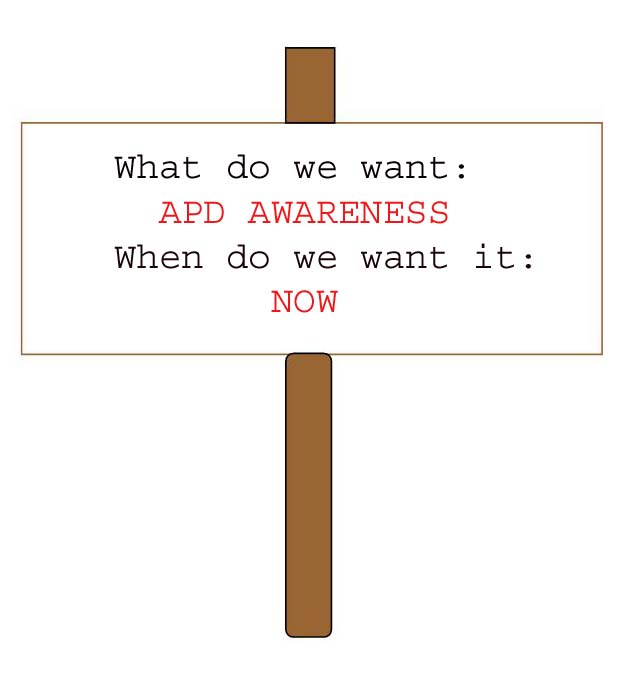
Happy APD Awareness Day

In 2009, a Minnesota teen named Megan Muehlberg (2012 Miss Minnesota Teen Internation 1st Runner Up) worked with former Governor Tim Pawley to make April 4, 2009 a statewide Auditory Processing Disorder Awareness Day.

To follow in her tradition, the APD support groups on Facebook (combined to be over 1000 members), have decided to spread the word internationally and "Break the Silence on this Silent Disorder" by honoring April 4, 2012 as International APD Awareness Day (even if no official has proclaimed it - maybe we can work on getting that recognition next year).

Two amazing teenagers with Auditory Processing Disorder created these images to spread across the internet:


APD Teen 23  (her blog is: APD Teen)


Tuesday, April 3, 2012

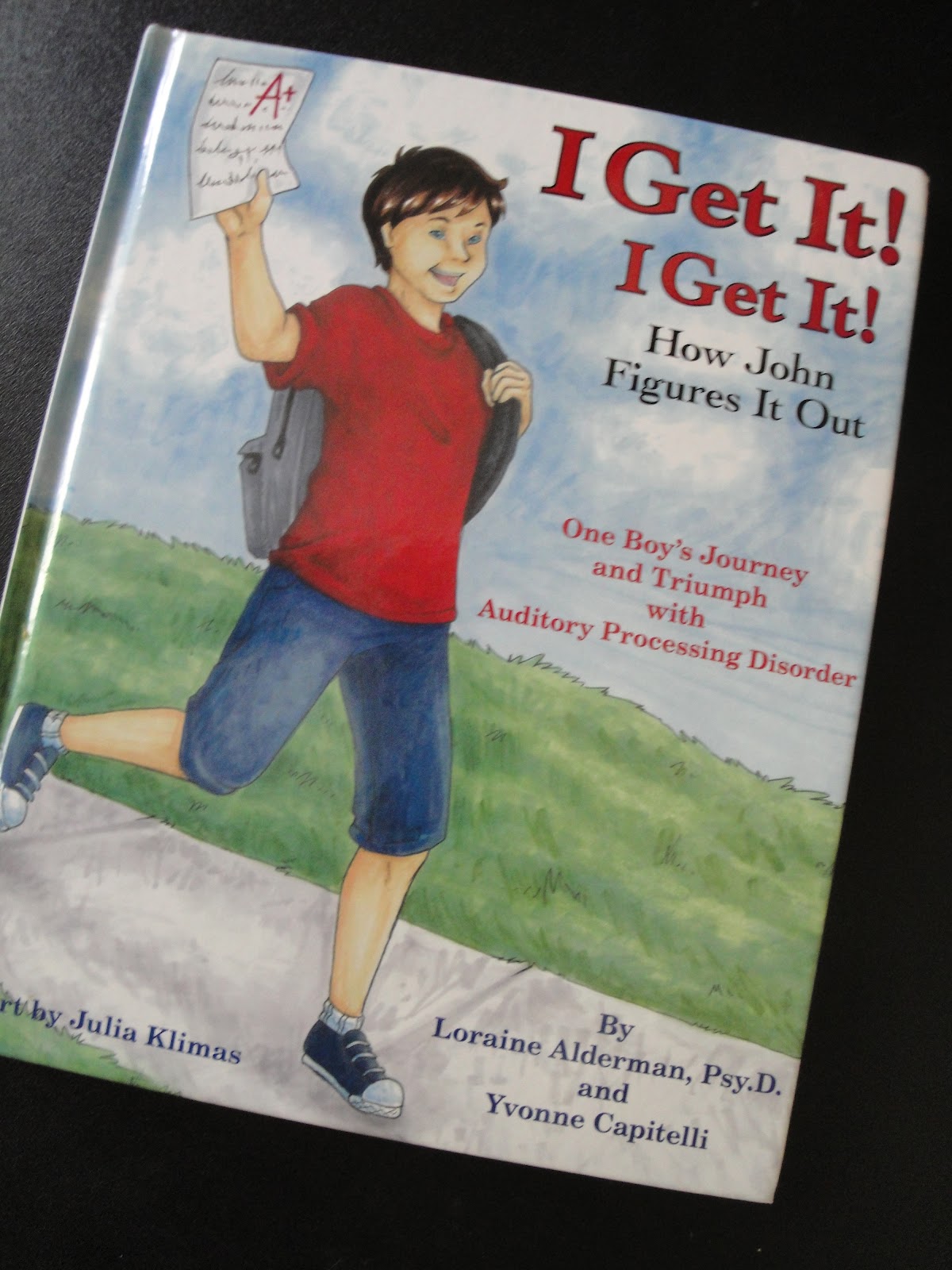
Book Review: "I Get It! I Get It! How John Figures It Out"

I just received my copy the new book I Get It! I Get It! by Loraine Alderman and Yvonne Capitelli.  As far as I can tell, it is the first book written for children about auditory processing disorder.

Overall, I think it is an excellent book.  The story flows well and definitely shows the main character John's frustration with not "getting it".  It also explains what auditory processing disorder is in a simple, easy to understand way.  There is even some great helpful advice for parents and teachers.

Of course, it doesn't explain everything about auditory processing disorder and neglects to point out the social difficulties that come with the disorder or some issues such as the fatigue that usually accompanies the disorder due to the extraordinary effort it takes to process auditory information.  (Co-morbid common conditions such as dyslexia, discalculia, sensory processing disorder, or anything else are also not mentioned.)  However, I believe the intent was to keep it simple as the audience is elementary aged children.

I would definitely recommend this book and I sincerely hope it is the first of many more to come.

Saturday, March 24, 2012

Mini-Panic Attack Like Only A Mom With A Child with Special Needs Can Know


Today I went to the informational meeting for my daughter's ice skating show.  Everything was going along well when suddenly I heard that parents are not allowed in the locker rooms with their child.  Not only that but the children have to stay in their designated locker rooms at all times except when they are performing.

My heart started thumping as my mind raced over the problems with this situation: my daughter will be stuck in a room with 20-30 noisy kids not being able to process much of any speech due to the noise.  She won't necessarily know what she's supposed to be doing when the person in charge tells them to put on their skates and get ready to go.  She hates a lot of noise; she hates chaos; she hates to feel lost and most likely, she'll start to feel overwhelmed locked in a room full of  20-30 bored, anxious, loud, moving children.  She might begin to feel panicked. Performing in the show is enough anxiety to learn to deal with. We don't need to provide anymore.

My hand darted up like the child desperate to get called on.  "My child has a communication problem.  Can I stay in the locker room with her?"

"You'll have to volunteer to be a locker room attendant for all performances and be willing to help ALL the children."

To myself I thought, well of course I'll help all the children as much as possible.  But I cannot be solely in charge of all of them because my daughter will need me and that is my primary concern.

So I calmly stated that I would lovingly help all the children, but I would need someone else to help - I could not possibly do it alone due to my child's needs.  What do you know, a woman sitting beside me volunteered to be a locker room attendant with me for all three performances.  She has a child in the same group, and she said she works with senior citizens who have auditory difficulties (usually due to hearing loss) so she understands my concerns.

Phew!  Everything worked out just fine - panic attack over.  I love it when kind people provide.* Once again, asking worked.

*As an added bonus, the director of the program is going to coach my daughter's group performance number and she made a point to let me know she is aware of her needs and will be considerate of them. I love this ice skating program.

Saturday, March 17, 2012

Friends Like Me: How Facebook United Kids with Auditory Processing Disorder

Friendship is born at that moment when one person 
says to another, "What! You too? I thought
 I was the only one!" by C. S. Lewis 

Good friends really do make such a difference in one's life.  A few months ago, some of the mothers in our Facebook support group for parents who have children with Auditory Processing Disorder (APD)* decided to get our children in contact with each other.  We live around the world, but a group of us all have girls around the same age with APD.  Inspired by a group of teenage girls we know who have APD and have expressed how much their friendships with each other have been so beneficial to them, we had our girls start writing to each other. Gradually they started to get to know each other and recently they started to Skype and text with one another. It has been fantastic!

If you've been following my posts on this blog, you will remember the post I wrote about Maslow's hierarchy of needs.  One of the important foundations for building self-esteem is to provide a sense of belonging.  Having a processing difference/learning disability can sometimes make fitting in with the other kids a difficult thing for our children.  Many a parent can tell you how our children regularly express the feelings of being singularly different and no one truly understanding what life is like for them.  So providing our girls with not only other people who have APD, but girls their own age who have APD, has provided them with a sense of belonging that goes beyond what any of us probably ever imagined.

So thank you Mark Zuckerberg for creating Facebook!  I know Mark never intended or even imagined that Facebook would be helpful to a group of children with Auditory Processing Disorder, but in an indirect way, it has connected people who would not have otherwise even met.  (Also thank you Niklas Zennstrom for creating Skype which connects our girls face-to-face.)


* The group is for both parents of children with APD and individuals themselves who have APD.  My post from February 27, 2012 has the names of these groups for anyone who is interested.


Wednesday, March 7, 2012

APD Awareness: Having APD is sort of like Speaking a Foreign Language

Auditory Processing Disorder (APD) can be subtle and because of this, children with APD are often penalized as being non-caring, not-intelligent, and/or not-attentive.  The reality is so far from this non-understanding viewpoint.

Imagine if you can being in a foreign country.  You know the language to some extent, but you have to process everything you hear from the foreign language to your native language to understand and back to the foreign language to communicate.  It takes time.  Sometimes the person speaking to you doesn't realize this time delay and they speak too rapidly for you to process everything.  Or maybe people are speaking over each other and it is difficult to hear exactly what is being said.  So you process about 2 to 3 words maximum out of every sentence.  You try piecing this fragmented information together to make some sort of sense.  Of course by this time the person speaking to you thinks you are rudely not responding.  Then, when you do say something, the person looks at you like you are a complete idiot because your response is actually not accurate for the conversation.  You try to apologize and explain that you speak a different language and you're doing your best.  But what if they don't believe you?  What if they think you are simply  non-caring, not-intelligent, and not paying attention?  This happens to people with APD all the time!

Of course, just like you can translate the foreign language if given the time you need to do so (and maybe some clarification here and there), so can our kids with APD.  You can also speak intelligent sentences and express your wonderful thoughts and ideas even in the foreign language if given the time to do so.  Sure you might forget a word here or there or conjugate a verb incorrectly, but that's really no big deal so long as the person you are speaking to is understanding and patient.  It is no less important that our children with APD have people be understanding and patient with them.

It is my hope that the world becomes aware of Auditory Processing Disorder and uses that knowledge to show compassion to people with APD.  Be understanding!  Be patient!  Give them the time and respect they need to shine!  They ARE intelligent, attentive, and caring.

Monday, February 27, 2012

Facebook Auditory Processing Disorder Support Groups

"I would like to thank all of the moms on this board.  I knew nothing at the first meeting last spring and think my daughter took a hit for that.  Every move, email, notice and meeting from me to the school district since December has been based on the knowledge shared on these boards.  After all my emotional appeals, it has all come down to information, knowledge, perseverance, and not being backed into a corner. I used strategies developed by the members of these APD boards." Lizette Biel

There are a number of support groups for people and/or parents of people with auditory processing disorder on Facebook.  Please join our on-line community:


Thursday, February 16, 2012

Helping Our Children With Special Needs Deal with Anxiety


Anxiety displacement is something I have been thinking about lately.  I’ve been researching what I can find about it with very little success.  There’s huge amounts about anger displacement, but what about the very real existence of people taking anxiety from one situation and displacing it onto anxiety about everything that ever happened or will happen.

The Problem:

You see, I’ve run into a pattern in my daughter’s life.  Whenever she has anxiety about something, it spills onto everything else.  If she has a dentist appointment, she’ll have an entire day of thinking about all the ills she has ever suffered in life and worries about them happening again.  She will get into that old stuck needle on the record place where no matter what anyone says or does, she is incapable of not worrying about everything.

I’ve read account after account of other parents discovering the same pattern with their child – particularly with children whom have special needs.  The intensity of the anxiety seems to be so overwhelming, that I believe the child displaces it onto familiar scenarios in an attempt to manage it.   Therefore, I think it is anxiety displacement.  Here is an example of how it goes:

What I’ve learned over the years is that my daughter is displacing the anxiety of going to the dentist onto everything else.  She doesn’t know how to handle the intensity of her fears and she goes to the old stand-bys that she has grown used to.  She has worried about her weight, her reading, misunderstanding, being bullied, having people not understand her, etc.  These are old pains and old worries that we have worked through repeatedly.  She knows the response she will get when she brings them up, and she hopes these responses will make her feel better – make the current fear go away.  The only problem is they can’t.  Hearing me remind her how well she reads now doesn’t make her fear of going to the dentist go away.  So she moves on to the next old fear or pain with the same result.  As you can imagine, this is exhausting and futile for both her and me. 

My Solution:

So what I have finally learned is to not go down that path with her.  I simply tell her that she is bringing up old worries and that they are not her problem right now.  If I know what she is most likely having anxiety about, I talk to her about that and that only. I tell her that we can talk about those old worries later if she still wants to, but not now.  For instance, when she had a dentist appointment, I told her we could talk about her worries about going to the dentist but those old worries would have to wait until after the dentist appointment, because they were probably not real worries today – just triggered from her current worry about the dentist.  (Of course after the dentist appointment was over, she felt fine and no longer wished to talk about any worries.)

We also focus on feeling better right now.  We have talked extensively about how all people’s brains don’t work well when we are in the middle of intense emotions and how we need to calm our mind before it will work well.  Therefore, we focus on doing things that calm our minds.  For my daughter, this is chewing gum, smelling lavender, being squeezed, and doing relaxing activities like singing, dancing, or watching a fun show.

Prevention Works Best:

Furthermore, I’ve found that if I can prepare for the anxiety inducing event ahead of time, life goes more smoothly for all of us.  What this means is as mother, I know an event like a dentist appointment might provoke anxiety, so I plan on doing non-stressful fun events and calming things that day.  I don’t plan other things for that day for her or myself, and I make sure I get enough rest and sustenance to manage the emotional day I have ahead of me.  As my daughter gets older, she learns more how to do these calming things for herself and how to plan her life herself to allow for such things.  That is our goal: to help her learn how to calm herself, deal with anxiety, and prepare for stressful events whenever possible.


Saturday, January 28, 2012

Group Lessons??? The Coach Makes All The Difference

Recently my daughter Hailey started to take off-ice lessons as well as her twice weekly figure skating lessons. These are lessons where they do aerobic exercises, strengthening exercises, stretching exercises, and practice jumps in their sneakers - off the ice.  Her lessons on the ice are one-on-one with a coach that she adores and works very well with. Her off-ice lessons are in a group format with nine other girls.  She also has a new coach for these lessons whom she is not familiar with and to top that off, she has an accent.

At first, I was concerned that these off-ice lessons would not work for Hailey.  She generally just falls apart in group lessons: she can't understand what is going on, what she is supposed to do, and the atmosphere feels too chaotic for her.  She also doesn't usually do well understanding people who have accents.

Pleasantly, we have both been surprised!  Her new coach for the off-ice lessons makes a point of telling the students what to do and briefly showing them.  Then she taps Hailey on the shoulder to get her attention and shows her step-by-step how to do the activity with Hailey following along.  It works wonderfully. Hailey understands how and what to do so she doesn't feel like things are out of control.

The other girls can still be noisy and active around Hailey, but she seems to be handling it well.  She just focuses on what she needs to be doing and doesn't let them distract her.  Sometimes one will get into her space a little too close (like they might accidentally kick her) and she either moves herself or the coach motions for her to move to a larger spot.

Overall, I'm happy that Hailey is doing so well in a group lesson.  Not only because she is getting the instruction she needs for ice skating, but she is also tolerating a group of noisy, active kids around her.  This is a milestone!


PS:  I didn't even have to talk to the new coach about Hailey's needs.  Hailey's original coach, her on-ice coach, explained it to her ahead of time.  Yippee!  How wonderful to have people who are so caring and pro-active for my child.


Monday, January 9, 2012

Strategies for Managing Auditory Processing Disorder

The management of Auditory Processing Disorder (APD) consists of three main categories: 1) Environmental Modifications; 2) Remediation (Direct Therapies); and 3) Compensatory Strategies.

As not every person with Auditory Processing Disorder has the same exact problems to the same exact extent, it is important to keep in mind that not all strategies work for everyone nor are all needed for everyone.  Moreover, many times Auditory Processing Disorder is one disability/difference of many for an individual; some conditions such as Dyslexia, Sensory Processing Disorder, Visual Processing Disorder, Attention Deficit Disorder, and various language disabilities are common co-existing conditions.

Environmental Modifications:

Environmental modifications are things that are done to make the environment for a person with Auditory Processing Disorder most able to function at his or her best for learning, working, and/or living.  Some examples of these are*:

  • Preferential seating to be nearest the speaker and away from environmental noises such as heaters or fans;
  • Visual cues and aids used in presentations to assist with comprehension of the material being covered;
  • Written notes provided so that full attention can be on the speaker and not on trying to take notes at the same time;
  • Study guides or outlines provided before the lecture so that the person with APD can become familiar with the material and vocabulary ahead of time;
  • A school FM sound system or a personal FM system to allow the person with APD to hear the speaker directly without as much environmental noise;
  • The speaker pausing at phrases rather than speaking in long, complicated sentences;
  • Always insuring that the person with APD has the ability to see the face of the speaker;
  • Permitting the person with APD more time to process information - both input and output;
  • Provide or allow the use of lists or other devices (such as recording devices) to assist with auditory memory problems; 
  • Noise reducing headphones for the person with APD who is sensitive to sound when direct listening is not necessary - such as during a test or when reading;
  • For the young child, picture cards are a valuable asset to assisting the child with communication. These can be made at home or purchased; and
  • Many publishers of textbooks (Harcourt Brace, Houghton Mifflin, Pearson, Macmillian/ McGraw Hill, Holt McDougal & Houghton Mifflin Harcourt, Pearson Prentice-Hall, Pearson K-12) also have electronic textbooks that are available.  They are interactive and play on a computer.  I've been told that school districts are the only ones that can order them at the k-12 level.  I've also been told that some are accessible to be read by a text to speech reader application such as Adobe Acrobat 6. This is something to look into if reading speed is a problem for the student with APD.  

Remediation (direct therapy):

Remediation is controversial for Auditory Processing Disorder.  There are a number of therapy programs available and all have mixed results.  Some people may find one therapy incredibly helpful while others may find that same therapy to be useless.  

Remediation should also be aimed at the particular needs/circumstance of the individual with Auditory Processing Disorder.  Therefore, if a child is having problems processing speech, a speech therapist would be advisable.  If a child is having difficulties learning to read, a reading intervention program would make sense. Keeping this in mind, here is a list of some possible therapies*:


Compensatory Strategies:

Compensatory strategies are ways in which the person with Auditory Processing Disorder uses other skills to help him or her best cope with his or her auditory processing problems.  These are language, conversation, organizational, and social skills that have been taught or encouraged and practiced.  Some examples of these are:

  • Identifying body language and facial expressions;
  • Lip reading;
  • Social skills training such as role playing different scenarios;
  • Using the practice of rephrasing what someone says as a way to halt the conversation and use that time to better process what was said and compose a response;
  • Speaking up for oneself and one's needs such as asking people to repeat or clarify something;
  • Utilizing environmental modifications such as making a point of positioning one's self near to and looking at a speaker as much as possible;
  • Using texting or e-mail to communicate;
  • Using written reminders or lists to compensate for auditory memory problems; and
  • Use visualization techniques to remember things: make a picture in one's mind of the event or concept.

* All links posted here are only one company providing the service or product listed.  Please research to find which provider you prefer.